
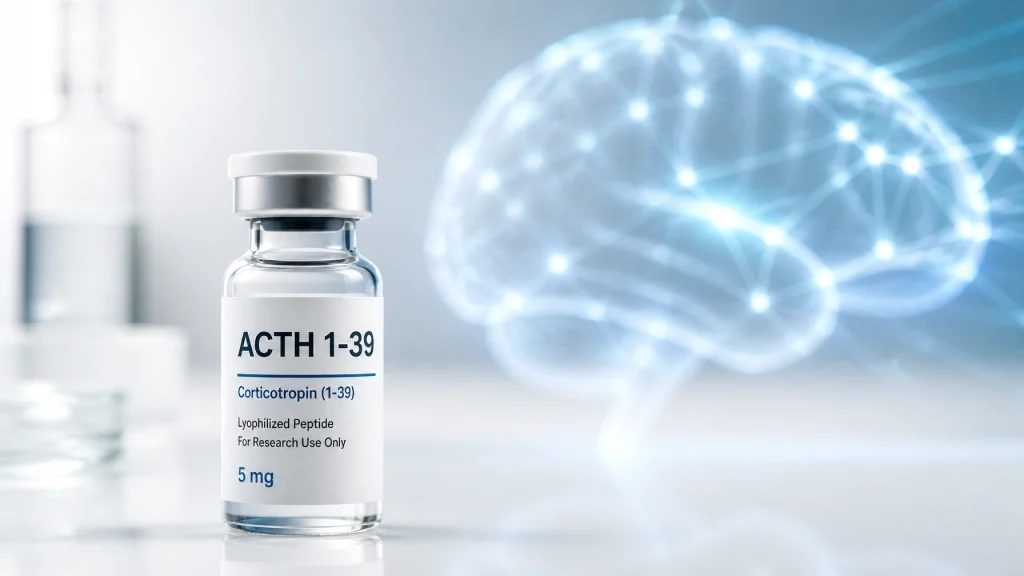
The Adrenal Myth: Breaking the Steroid Dependency
For decades, the medical community assumed the benefits of ACTH were synonymous with the benefits of glucocorticoids. The logic was simple: ACTH raises cortisol, and cortisol suppresses inflammation.
However, recent research has thrown a wrench in that simplistic gear. Scientists have observed that ACTH 1-39 provides neuroprotection even in subjects where the adrenal glands have been removed. This means the peptide is doing something directly in the brain.
ACTH 1-39 is a 39-amino acid peptide derived from proopiomelanocortin (POMC). While its “day job” involves the MC2R receptor in the adrenal cortex, its “night life”: and perhaps its most exciting role: involves a family of receptors scattered throughout the Central Nervous System (CNS): the Melanocortin Receptors (MC1R, MC3R, MC4R, and MC5R).

Unlocking the Melanocortin Shield
To understand how ACTH 1-39 revolutionizes brain health, we have to look at how it interacts with the CNS. It doesn’t just pass through; it engages.
1. Combating Excitotoxicity: The Neural Firewall
One of the most transformative discoveries in peptide research is ACTH’s ability to shield neurons from excitotoxicity. This occurs when neurotransmitters like glutamate overstimulate neurons to the point of cell death: a common issue in traumatic brain injury and neurodegenerative decline.
ACTH 1-39 acts as a biological firewall. By activating specific melanocortin receptors (primarily MC3R and MC4R), it helps regulate the influx of calcium and protects the mitochondria within the neuron. In research settings, ACTH has been shown to protect primary forebrain cultures from glutamate-induced damage, effectively keeping the “circuitry” from frying under pressure.
2. Radical Anti-Inflammatory Action (Without the Steroid Side Effects)
Inflammation is the silent killer of cognitive longevity. While high doses of synthetic steroids can cause a host of issues: from bone density loss to metabolic disruption: ACTH 1-39 offers a more nuanced approach.
By binding to MC1R on microglia (the brain’s resident immune cells), ACTH 1-39 suppresses the activation of NF-κB. This is the “master switch” for inflammation. When you flip this switch off, you reduce the production of pro-inflammatory cytokines like TNF-α. This creates a calm, high-performance environment for neural processing.
3. Stabilizing the Blood-Brain Barrier (BBB)
Newer studies, particularly in early-life seizure models, have shown that ACTH 1-39 helps normalize astrocytic proteins like GFAP and AQP4. This isn’t just jargon; it’s the structural integrity of your brain’s defense system. By stabilizing astrocytes via the MC4R pathway, ACTH 1-39 helps maintain the Blood-Brain Barrier and water homeostasis, ensuring the brain remains a pristine environment for research-grade performance.