
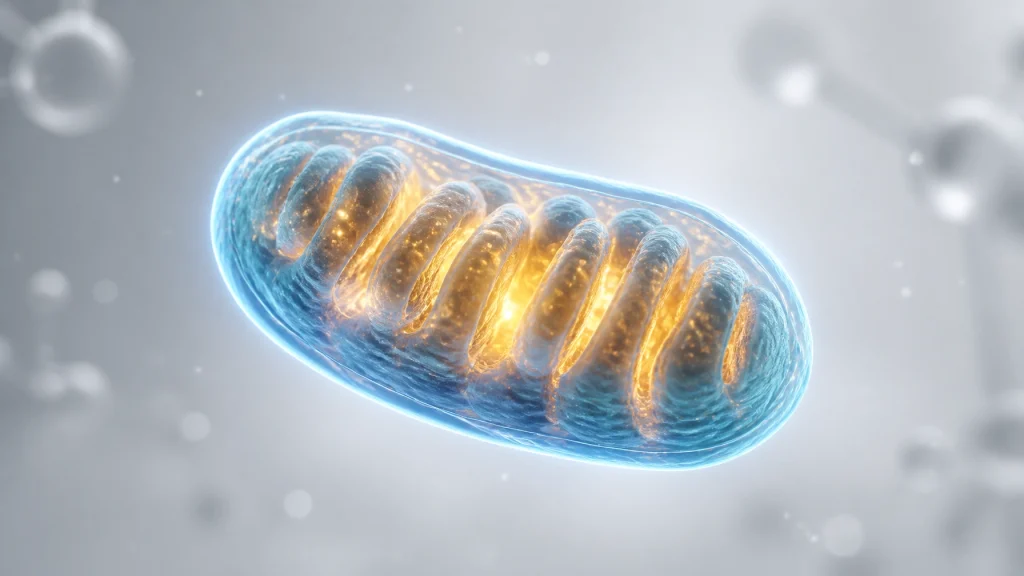
The Engine Room: Mitochondria and ATP
Before we can understand how BAM15 “uncouples” fat, we have to understand how our cells normally burn fuel.
Every cell in your body (well, almost every cell) contains mitochondria. These are the powerhouses that take the food you eat and turn it into ATP (Adenosine Triphosphate), the universal energy currency of life. This process is called oxidative phosphorylation.
Think of it like a hydroelectric dam. The mitochondria pump protons (H+) across a membrane, creating a high-pressure reservoir. When those protons flow back through a specific “turbine” called ATP synthase, they generate ATP. In a perfectly efficient system, every calorie burned is “coupled” to the production of energy.
What is Mitochondrial Uncoupling?
Mitochondrial uncoupling is the process of poking “leaks” in that dam. Instead of the protons flowing through the ATP synthase turbine to make energy, they leak back across the membrane through other channels.
When this happens, the cell realizes it isn’t making enough ATP to meet its needs. To compensate, it starts burning fuel (glucose and fatty acids) at a much faster rate to try and maintain that proton gradient. This is uncoupling. You are essentially wasting fuel to produce nothing but heat.
From a research perspective, this is incredibly exciting. If you can safely uncouple mitochondria, you can theoretically increase energy expenditure (the calories your body burns) without requiring extra physical activity.
