
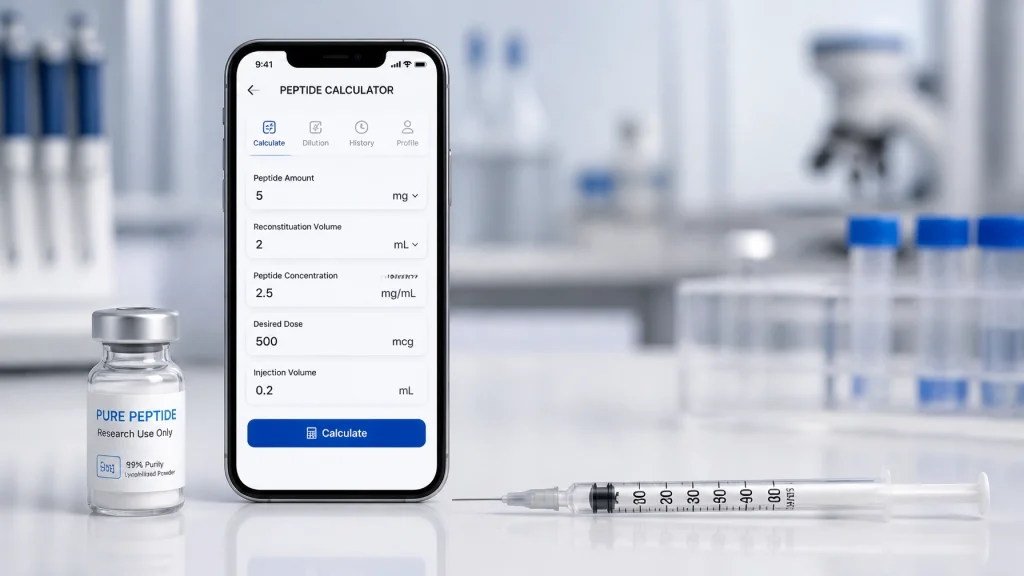
The Biohacker’s Toolkit: Essentials for Reconstitution
Before you unlock the potential of your lyophilized (freeze-dried) powder, you need the right medium. In the world of high-end research, Bacteriostatic Water (Bac Water) is your only choice. Unlike standard sterile water, Bac Water contains 0.9% benzyl alcohol, which acts as a preservative, inhibiting bacterial growth and allowing your reconstituted solution to remain stable for multi-use research over several weeks.
Why Quality Matters
When you’re dealing with advanced compounds for metabolic function or longevity, using “just any water” is a rookie mistake. Impurities can degrade the delicate peptide chains, rendering your research useless. At WLA, we advocate for pharmaceutical-grade supplies to match our pharmaceutical-grade research compounds.

The Syringe Selection: 0.5ml vs. 1ml Insulin Syringes
One of the most common questions we get at WLA is: “Does the syringe size actually matter?”
The short answer: Yes, for visual precision.
All standard U-100 insulin syringes are calibrated the same: 1ml = 100 units. This means 1 unit is always 0.01ml. However, the physical experience of dosing varies between sizes.
- The 1ml (100-Unit) Syringe: This is the workhorse of the lab. It’s perfect for drawing your Bac Water during the initial reconstitution phase. It has a larger barrel, making it ideal for when you need to move 1ml to 3ml of diluent into a vial.
- The 0.5ml (50-Unit) Syringe: This is where “Scientific Luxury” meets practical utility. Because the barrel is slimmer, the individual unit markings are spaced further apart. If your research protocol calls for a micro-dose (like 4 or 8 units), the 0.5ml syringe offers superior visual clarity, reducing the risk of “dosage drift.”
For most WLA researchers, we recommend using a 1ml syringe to “recon” the vial and a 0.5ml syringe for the actual research dosing.
