
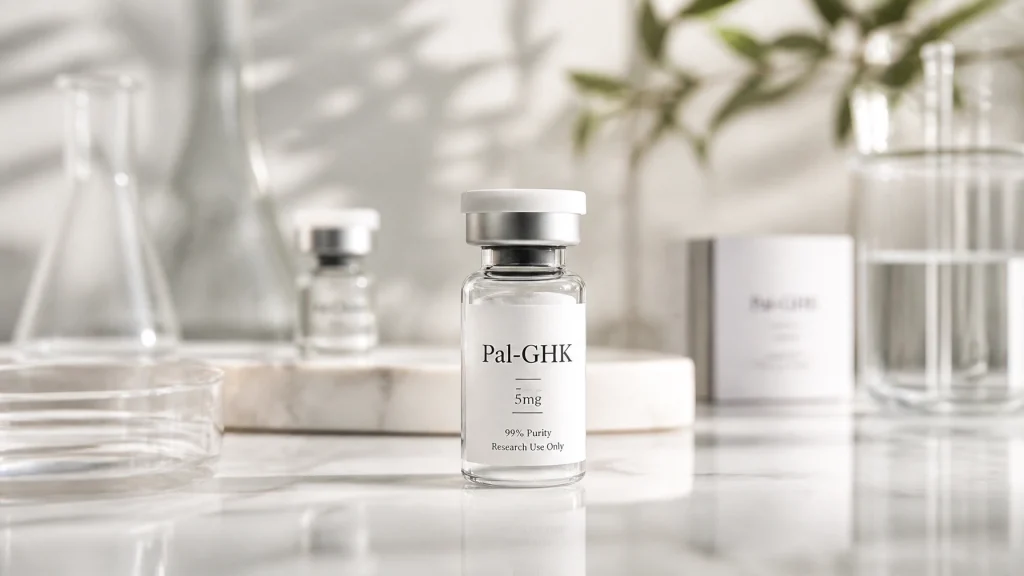
The Science of “Stealth” Delivery: What is Palmitoylation?
To understand why Pal-GHK is a scientific luxury, we have to look at the chemistry of the skin. Our skin is designed to keep things out. The stratum corneum (the outermost layer) is rich in lipids, which acts as a barrier to water-soluble molecules. Standard GHK-Cu is phenomenal, but it is hydrophilic: meaning it loves water but struggles to push through that oily skin barrier.
Enter the Palmitoyl Group.
Palmitoylation is the process of attaching a palmitic acid (a C16 fatty acid) to the peptide. This transformation turns a water-seeking peptide into a lipid-friendly “stealth” molecule.
- Increased Lipophilicity: The peptide now “blends in” with the skin’s natural oils.
- Enhanced Permeation: It traverses the stratum corneum more efficiently to reach the dermal fibroblasts.
- Superior Stability: The fatty acid chain provides a level of structural protection against rapid enzymatic breakdown.
At Weight Loss Australia (WLA), we focus on sourcing research compounds that don’t just look good on paper but actually reach their target pathways. You can explore our full range of high-stability research peptides at wlaustralia.com.au.
Revolutionize the ECM: Mechanism of Action
Pal-GHK operates as a “messenger peptide.” It effectively tricks the skin into thinking that collagen has been broken down, which triggers a biological “emergency repair” response. This is the Problem-Solution Framework at its finest: the biological need is tissue degradation, and Pal-GHK is the high-tech solution.
1. Fibroblast Activation
Once Pal-GHK reaches the dermis, it stimulates fibroblasts: the “construction workers” of your skin. These cells are responsible for the synthesis of the Extracellular Matrix (ECM). Research shows that Pal-GHK significantly upregulates the production of:
- Collagen Type I & III: The structural pillars that provide firmness.
- Elastin: The protein that gives skin its “snap back” or elasticity.
- Glycosaminoglycans (GAGs): Like hyaluronic acid, these molecules hold onto moisture, creating that deep-tissue hydration.
2. MMP Regulation
It’s not just about building new tissue; it’s about managing the old stuff. Pal-GHK helps regulate Matrix Metalloproteinases (MMPs), the enzymes that chew up damaged collagen. By balancing synthesis and degradation, it ensures the ECM remains robust and orderly, rather than a tangled mess of photoaged fibers.
3. DNA Repair and Antioxidant Pathways
Recent studies suggest that the GHK motif, when delivered effectively, can reset gene expression to a more youthful state. This includes upregulating Nrf2: a master regulator of the body’s antioxidant response: and supporting DNA repair mechanisms after UVA exposure.
