
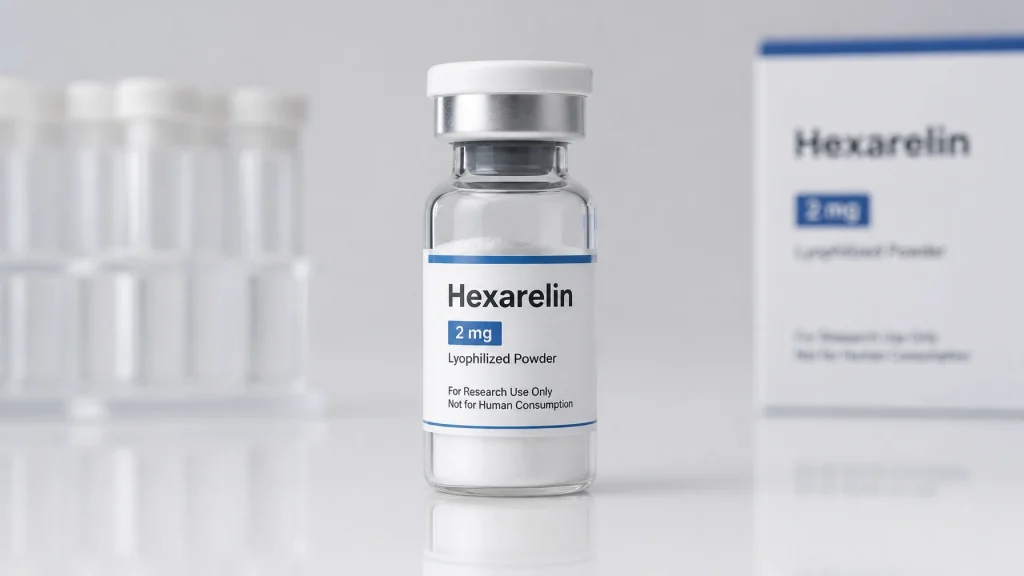
What Exactly is Hexarelin?
Scientific Function: Synthetic Hexapeptide / Ghrelin Receptor Agonist
Physical Contents: 2mg or 5mg Lyophilized Hexarelin Acetate
Hexarelin (often called “Hex” in advanced research circles) is a potent growth hormone-releasing peptide. Structurally, it’s a hexapeptide analog of GHRP-6, but don’t let the family tree fool you: this is a far more refined and powerful tool. It functions as a ghrelin (GHSR-1a) receptor agonist, which is a fancy way of saying it signals your pituitary gland to release a massive surge of natural growth hormone.
But here’s the kicker that sets WLA’s Hexarelin apart: it doesn’t just stop at the pituitary. It also interacts with the CD36 receptor found in the heart and blood vessels. This dual-action mechanism makes it a subject of intense study for both muscle growth and cardiovascular resilience.
The Science of Secretion: How Hexarelin Works
When you introduce Hexarelin into a research environment, you’re triggering a cascade of biological events. Unlike GHRH (Growth Hormone Releasing Hormone) analogs that simply encourage the production of GH, Hexarelin is a secretagogue. It forces a pulse.
- Pituitary Activation: It binds to the GHSR-1a receptors in the anterior pituitary, causing an immediate release of GH.
- Hypothalamic Influence: It stimulates the hypothalamus to increase the release of natural GHRH while simultaneously inhibiting somatostatin (the “off switch” for growth hormone).
- The GH-IGF-1 Axis: Once that GH hits the system, the liver responds by increasing IGF-1 levels, the primary driver for cellular repair and tissue growth.
Because it bypasses some of the body’s natural rate-limiting steps, Hexarelin is widely regarded as one of the most potent GHRPs available: often producing a stronger pulse than the more commonly known GHRP-2 or Ipamorelin.
