
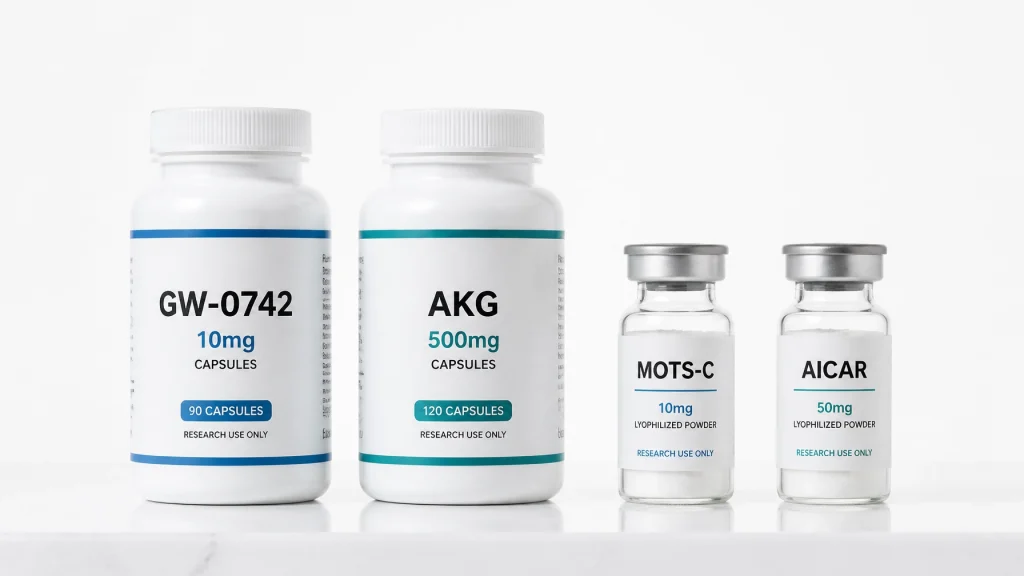
The Foundation: Your Mitochondrial Engine
Before we dive into the specific tools, you must understand the problem. Fatigue is often a sign of metabolic inflexibility. This is when your body struggles to switch between burning carbohydrates and burning fat for fuel. Think of your body like a hybrid car. If the electric motor (fat oxidation) is broken, you are forced to rely solely on the petrol engine (glucose). Once the petrol runs out, you “bonk.”
The Endurance Protocol aims to fix the hybrid system. We are targeting mitochondrial biogenesis: the creation of new power plants: and oxidative phosphorylation, which is the process of generating energy (ATP).
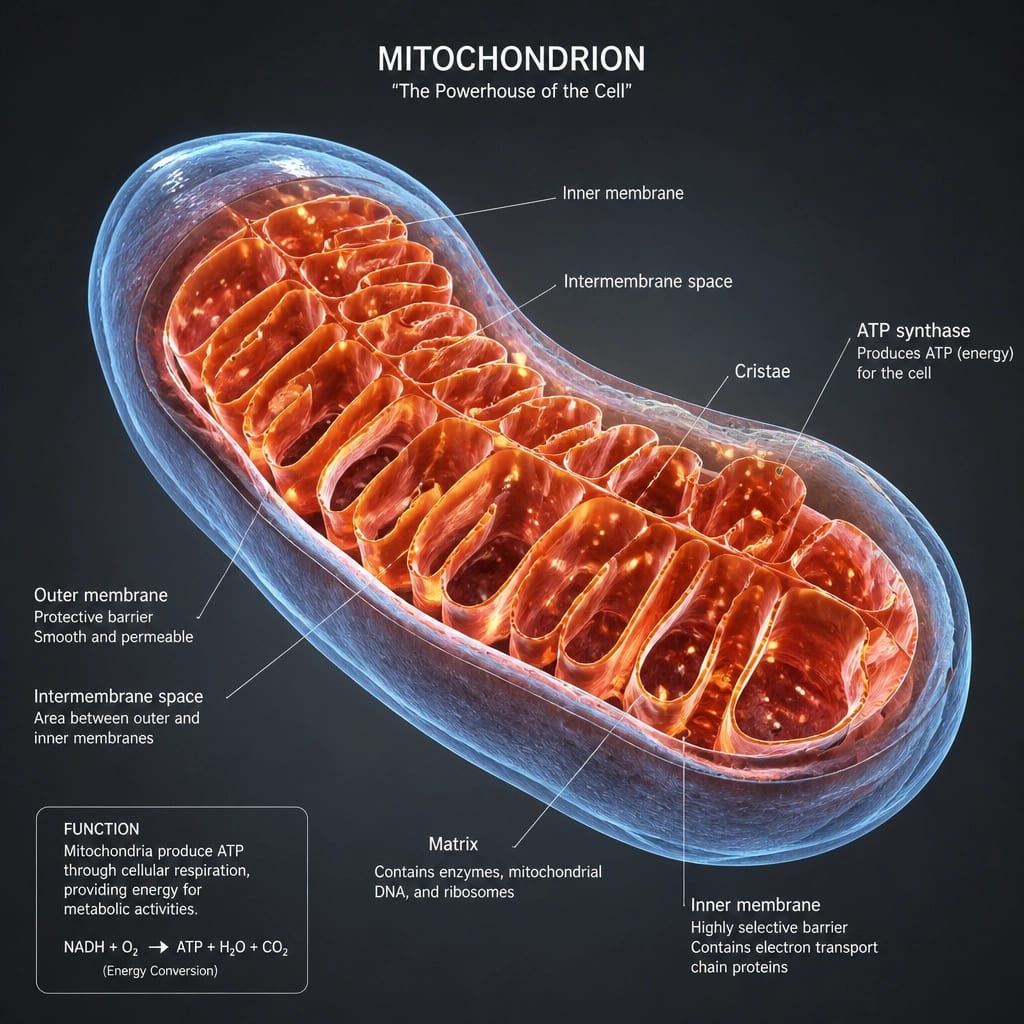
Step 1: The Spark: MOTS-C and AICAR
Focus on the “starter motor” of your cells. MOTS-C (Mitochondrial-Derived Peptide) is a 16-amino-acid peptide that acts as a signal to your body that it is time to exercise.
The Folate Cycle Analogy:
Imagine your cell’s energy production as a complex construction site. To get things moving, you need to clear away the debris first. MOTS-C inhibits what we call the folate cycle. By doing this, it naturally forces your body to raise levels of endogenous AICAR (5-Aminoimidazole-4-carboxamide ribonucleotide).
Consider AICAR the “emergency alarm.” When AICAR levels rise, they activate AMPK (Adenosine Monophosphate-activated Protein Kinase). AMPK is the master metabolic switch. When it’s “on,” your body stops storing fat and starts burning it; it stops being lazy and starts building more mitochondria.
By stacking MOTS-C with AICAR, you are essentially hitting the “accelerator” on this pathway. You are telling your muscle cells: “The demands are high. Build more engines. Now.”
