
The Death of the Spoon-Fed Mindset
Consider this: if you were driving a high-performance sports car, would you wait for someone else to tell you when to shift gears, or would you learn the rhythm of the engine yourself?
Many people enter the alternative medicine space with a “spoon-fed” mindset. They want the results without the research. They want a “one-size-fits-all” answer. But your biology is not a franchise restaurant; it is a unique, complex ecosystem.
The Problem: Dependency on others for basic instructions leads to errors, safety risks, and missed optimizations.
The Solution: Take full ownership. To be a “Responsible Researcher” means ending the search for easy answers and starting the search for understanding. You must be the primary investigator of your own health. This means continuous learning, meticulous record-keeping, and a refusal to cut corners.
- Focus on: The “Why” behind the “How.”
- Consider this: Every variable you control is a lever you can pull to optimize your outcome.
- Take Control: Stop asking “What do I do?” and start asking “How does this work?”
The Construction Site: Laying the Mathematical Foundation
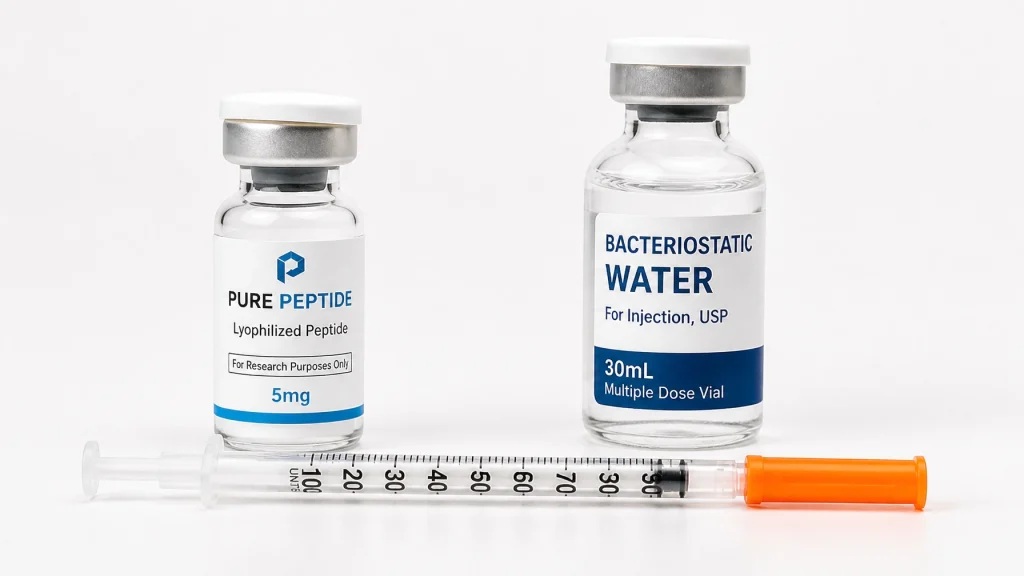
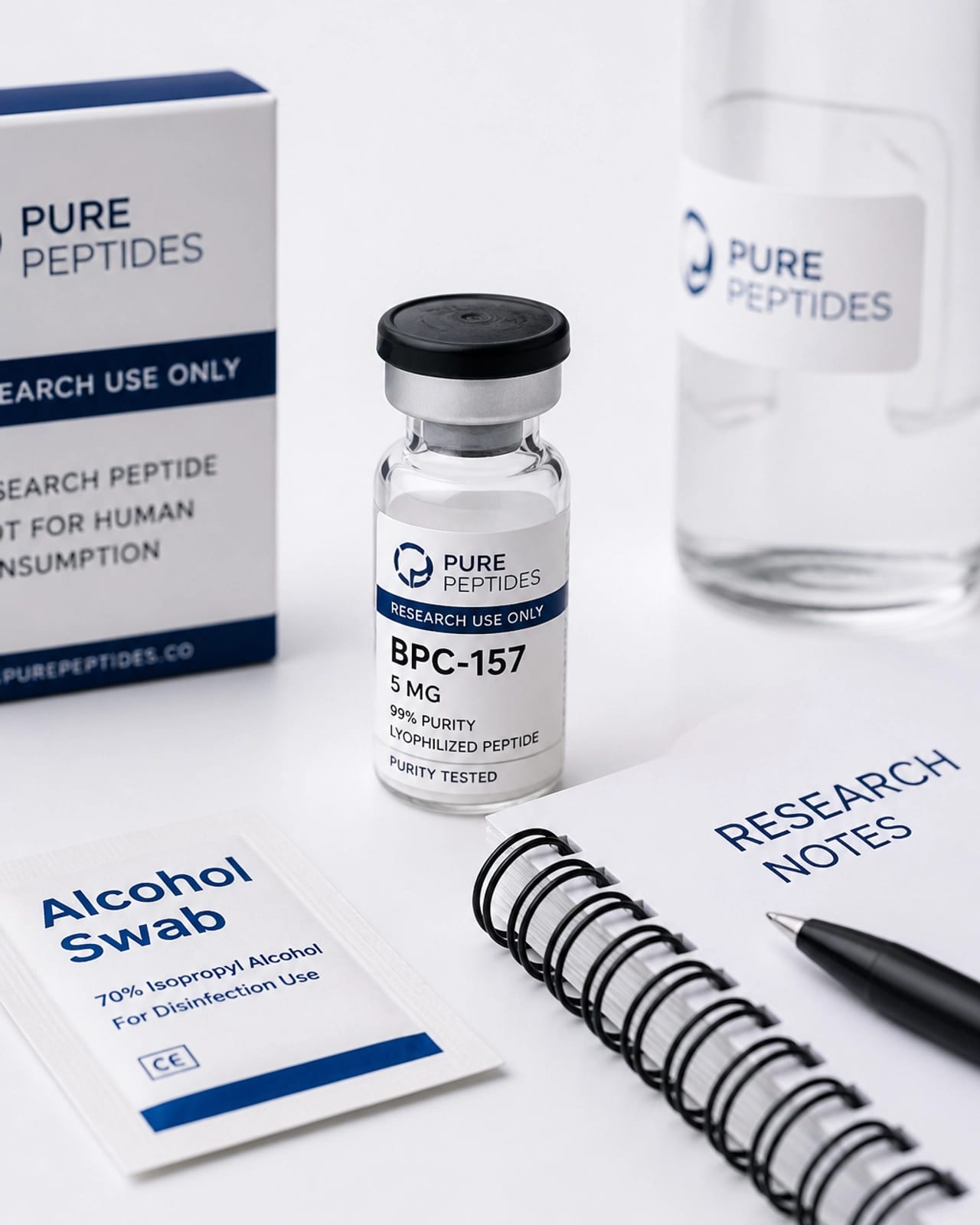
Before you can apply a peptide, you must reconstitute it. Most high-quality peptides, like those found in our featured collection, arrive as a lyophilized (freeze-dried) powder. This powder is stable but inert.
To “wake it up,” you need a solvent: specifically Bacteriostatic (BAC) Water. Reconstitution is the “zipper” that joins your research material with the medium that allows it to enter your system.
Blueprint Basics: Understanding mg vs. mL
Think of the peptide vial as a container of concentrated bricks (mg) and the BAC water as the mortar (mL) that allows you to move them.
- mg (Milligrams): This measures the mass of the peptide. It’s the strength of the “bricks.”
- mL (Milliliters): This measures the volume of the liquid. It’s the space the bricks will occupy.
The Golden Rule: 1 mg = 1,000 mcg (micrograms).
Most peptide research involves doses measured in mcg, but the vials are often sold in mg (e.g., 5mg or 10mg). If you miscalculate this 1,000-to-1 ratio, you aren’t just making a small error: you’re effectively trying to put a truck engine into a lawnmower. Accuracy is non-negotiable.
