
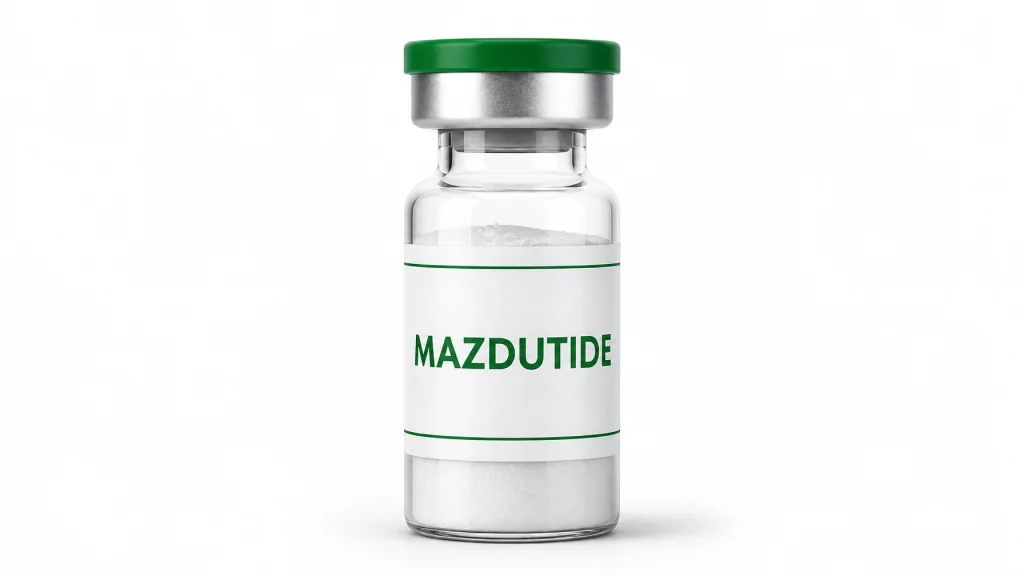
The Foundational Concept: What is Mazdutide?
Mazdutide (also known in clinical research as IBI362 or LY3305677) is a long-acting synthetic peptide designed to mimic the natural hormone oxyntomodulin. In the “construction site” of your metabolism, hormones act as the foremen, directing where resources are spent and where they are saved. While traditional weight-loss agents often focus on a single foreman, Mazdutide employs two.
It is classified as a dual GLP-1 and glucagon receptor agonist.
- GLP-1 (Glucagon-Like Peptide-1): This is the “Brake.” It tells your brain you are full and slows down the speed at which your stomach empties.
- Glucagon: This is the “Furnace.” Historically known for raising blood sugar, we now understand that when precisely balanced with GLP-1, it can significantly increase the rate at which your body burns fuel (thermogenesis).
By activating both receptors simultaneously, Mazdutide aims to achieve what single-target peptides: like standard Semaglutide: might miss: the active stimulation of energy burn while maintaining strict control over appetite.
The “Brake and Burn” Mechanism

To understand why this dual approach is revolutionary, imagine a car driving down a steep hill. If you only use the brakes (GLP-1), you will eventually slow down, but the engine is still idling. If you only rev the engine (Glucagon), you might burn more fuel, but you risk moving too fast and losing control (in biological terms, this would mean dangerously high blood sugar).
1. The GLP-1 Brake (Intake Control)
When you use Mazdutide, the GLP-1 component targets the hypothalamus in your brain. This section of the brain is the “Air Traffic Control” for hunger. Mazdutide signals that you are satiated, effectively silencing “food noise”: those intrusive thoughts about your next meal. Furthermore, it delays gastric emptying. This means the food you do eat stays in your stomach longer, reinforcing the feeling of fullness.
2. The Glucagon Furnace (Expenditure Activation)
This is where Mazdutide separates itself from older technologies. The activation of the glucagon receptor primarily occurs in the liver and adipose (fat) tissue. It triggers thermogenesis, a process where your body generates heat by burning calories. Research indicates that this can increase your resting energy expenditure by approximately 8% to 12%.
The Synergy: You will learn that the true power of Mazdutide lies in synergy. The GLP-1 component stimulates insulin secretion which counteracts the glucose-raising potential of glucagon. This balance ensures that while your “furnace” is burning hotter, your blood sugar remains stable.
| Feature | GLP-1 Receptor Action | Glucagon Receptor Action |
|---|---|---|
| Primary Goal | Reduce Food Intake | Increase Energy Burn |
| Organ Target | Brain & Stomach | Liver & Fat Tissue |
| Glucose Effect | Lowers Blood Sugar | Potentially Raises (Balanced by GLP-1) |
| Key Benefit | Early Satiety | Increased Metabolic Rate |
