
The Foundation: What are ERR Agonists?
To understand these compounds, imagine your body as a massive construction site. Your muscle cells are the workers, and the energy they use is provided by power generators called mitochondria. In a normal scenario, you have a set number of generators. When you go for a run or lift weights, your body sends a signal to “build more generators” to handle the increased workload.
ERRs (Estrogen-Related Receptors) are the project managers on this construction site. They don’t actually build the generators themselves; instead, they flip the switches that tell the DNA to start construction. There are three main types: ERRα (Alpha), ERRβ (Beta), and ERRγ (Gamma).
An agonist is a substance that acts like a master key, fitting into these receptors and turning them “on” without the need for actual physical labor. When you use an ERR agonist, you are effectively tricking your body into thinking it just finished an intense endurance session.
Problem: The Limitation of “Natural” Signaling
As we age, or due to environmental factors in the Australian climate (like extreme heat limiting outdoor activity), our natural signaling pathways can become sluggish. This leads to decreased mitochondrial density, slower fat metabolism, and a feeling of “hitting a wall” during physical exertion.
Solution: Direct Receptor Activation
By targeting the ERR pathway directly, you can bypass the need for hours of grueling cardio to trigger mitochondrial biogenesis (the creation of new mitochondria). This allows you to take control of your biology at a cellular level.

SLU-PP-332: The Original Pioneer
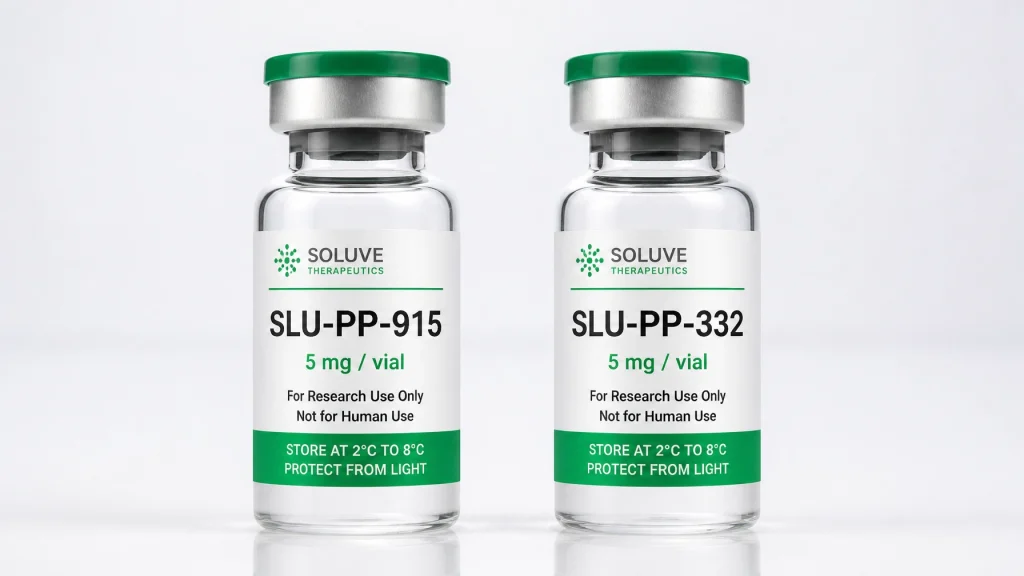
SLU-PP-332 was the first major breakthrough in this category. It is a pan-ERR agonist, meaning it activates all three receptors (Alpha, Beta, and Gamma). However, its “grip” is strongest on the Alpha receptor.
Potency and Mechanism:
Focus on the numbers: SLU-PP-332 is highly potent at the receptor level. It is particularly effective at driving fatty-acid oxidation (the process where your body burns fat for fuel) and converting fast-twitch muscle fibers into oxidative, endurance-focused fibers.
The Practical Hurdle:
While SLU-PP-332 is a powerhouse in a laboratory setting, it faces a significant challenge: low oral bioavailability. Bioavailability refers to the percentage of a substance that actually enters your bloodstream after you consume it. Because SLU-PP-332 is poorly absorbed by the gut, it often requires frequent injections to maintain effective levels in the body.
For many researchers and enthusiasts, the “problem” with 332 isn’t its results: which are robust: but the “maintenance” required to keep the engine running.
