
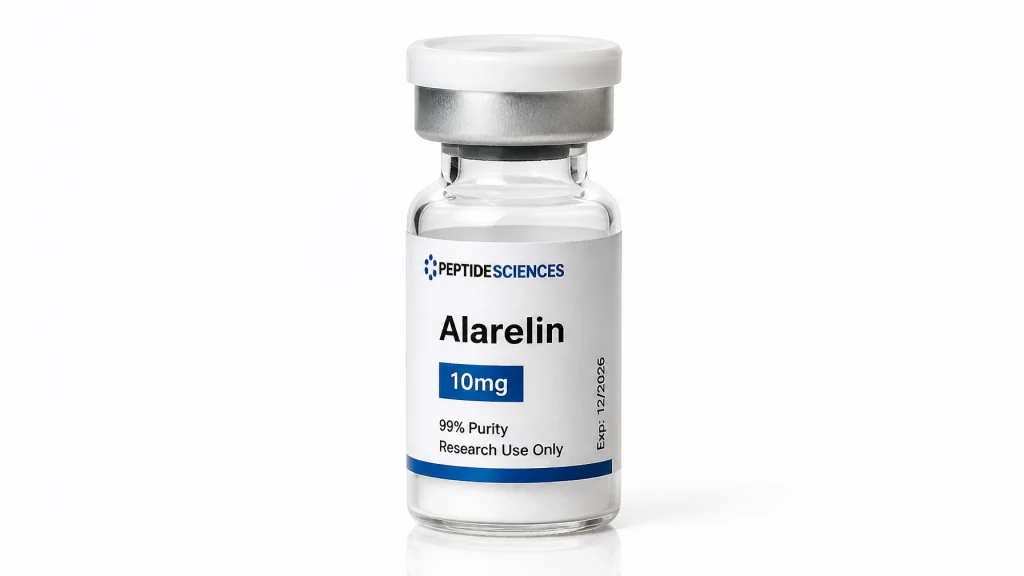
1. The Molecular Blueprint: What is Alarelin?
The Frustration: Biological Instability of Native Signals
When scientists first began studying Gonadotropin-Releasing Hormone (GnRH): the foundational decapeptide released by the hypothalamus: they encountered a major obstacle. Native GnRH is fragile; enzymes in the bloodstream break it down within minutes. Trying to study long-term hormonal feedback with native GnRH is like trying to build a brick wall with wet sand: it dissolves before the structure can take hold.
The Solution: Enzymatic Resistance and Receptor Optimization
To overcome rapid enzymatic degradation, researchers engineered synthetic nonapeptide analogs. Alarelin is a prime example of this optimization. By substituting a D-alanine at position 6 and adding an ethylamide on proline-9, biochemists created a molecule with extraordinary metabolic stability and heightened receptor affinity.
Think of native GnRH as a temporary key that barely turns the ignition lock, while Alarelin is a reinforced master key designed for a precise lock mechanism. With a binding affinity (Kd) of approximately 0.2 nM, Alarelin binds tightly to the GnRH receptors in the anterior pituitary gland. Its biological potency is 15 to 30 times higher than native GnRH in stimulating gonadotropin secretion.
| Feature | Native GnRH (Luteinizing Hormone-Releasing Hormone – LHRH) | Alarelin (Synthetic Analog) |
|---|---|---|
| Structure | Decapeptide (10 amino acids) | Nonapeptide (9 amino acids with D-Ala6 & Pro9-ethylamide) |
| Half-Life & Stability | Short-lived, rapid enzymatic cleavage | Highly resistant to degradation, extended duration |
| Receptor Affinity | Moderate binding efficiency | High affinity (Kd ≈ 0.2 nM) |
| Primary Utility | Short-term physiological testing | Advanced endocrine research, receptor desensitization studies |
Focus on this core principle: synergy and structural modification allow researchers to overcome natural biological degradation, unlocking precise experimental control.

2. Core Endocrine Mechanisms: Turning the Axis On and Off
The Frustration: Uncontrolled Hormonal Fluctuations
In complex biological systems, maintaining homeostasis is difficult because feedback loops constantly adapt to interference. If you want to study what happens when the reproductive command center is stimulated or silenced, random administration of hormones yields inconsistent, messy data.
The Solution: Biphasic Modulation of the HPG Axis
Alarelin acts as a powerful GnRH receptor agonist. To understand its dual action, think of a construction site manager who first shouts commands through a megaphone to ramp up crew activity, but then continuously blasts a siren until the workers temporarily tune it out and stop working.
- The Acute Phase (The Initial Flare): Pulsatile or acute exposure triggers an immediate surge in the release of Luteinizing Hormone (LH) and Follicle-Stimulating Hormone (FSH) from the anterior pituitary. This initial surge increases downstream sex steroid synthesis: such as estradiol, progesterone, and testosterone.
- The Chronic Phase (Desensitization & Suppression): Continuous, non-pulsatile exposure produces the opposite effect. Pituitary GnRH receptors undergo downregulation and functional desensitization. Gonadotropin secretion plummets, leading to hypogonadal levels of sex steroids.
This biphasic profile makes Alarelin an indispensable tool for experimentally turning the reproductive axis “on” for short-term stimulation studies or “off” for long-term suppression models.
Quick Summary: Alarelin’s dual capability: initial stimulation followed by receptor desensitization: provides researchers with total control over pituitary-gonadal feedback loops.
