
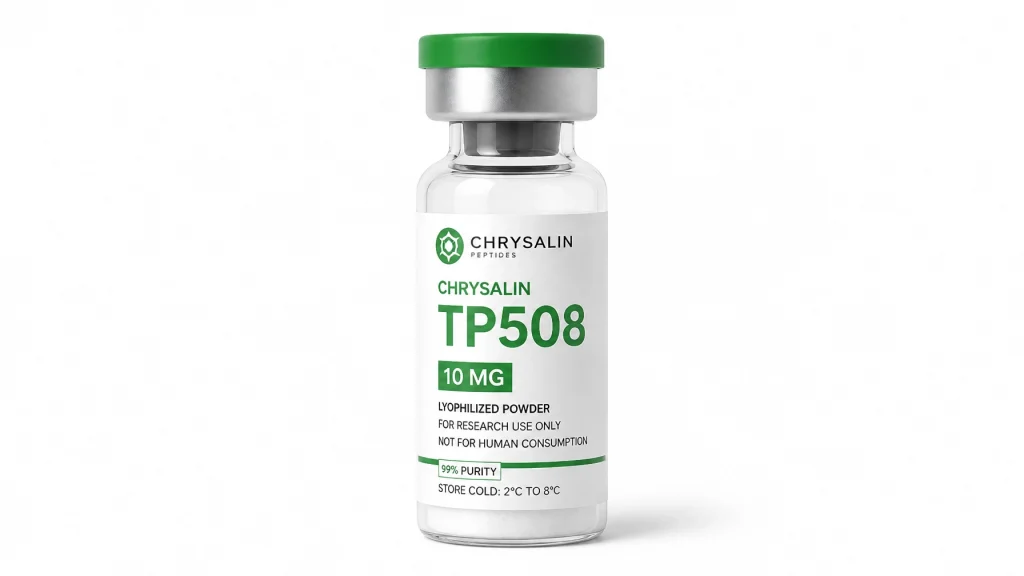
1. The Biological Blueprint: What is Chrysalin (TP508)?
The Problem: Clotting Risks vs. Repair Signals
In native physiology, thrombin is famous for one primary job: converting fibrinogen into fibrin to form blood clots and stop bleeding. However, using native thrombin as a therapeutic healing agent creates a catastrophic bottleneck: it causes dangerous thrombosis (blood clots). Researchers faced a formidable design puzzle: How do you isolate the healing magic of thrombin from its clot-forming curse?
The Solution: Receptor-Specific Peptidic Engineering
Focus on the breakthrough: TP508 represents amino acids 508–530 of human prothrombin, engineered specifically as a non-proteolytic domain. This means it retains the exact chemical “handshake” required to dock with repair-focused receptors on fibroblasts and endothelial cells, completely bypassing the clotting cascade.
- Analogy Time: Think of native thrombin as a heavy-duty industrial crane that both pours concrete and accidentally blocks traffic on the highway. Chrysalin is like a precision helicopter delivering elite engineers directly to the construction site without disrupting street traffic.
- Key Definition: Endothelial cells are the specialized monolayer lining your blood vessels, acting as the gatekeepers of vascular health and nutrient delivery.
[Video Placeholder: Watch our expert breakdown of TP508 receptor-binding mechanics and cellular signaling pathways]
2. Angiogenesis: Building Your Body’s Vascular Highways
The Problem: Nutrient Starvation in Injured Tissues
When tissue is damaged, local blood vessels are severed, plunging the injury zone into a state of severe hypoxia (oxygen deprivation). Without rapid vascular sprouting, healing stalls out, leaving scars and weak collagen matrices. In active individuals training in demanding outdoor climates across Australia, delayed microcirculation is the silent enemy of optimal recovery.
The Solution: Upregulating Vascular Endothelial Growth Factor (VEGF)
Consider this tiered strategy to supercharge your biological plumbing:
- Initiation: TP508 immediately stimulates endothelial cell migration and sprouting, encouraging new blood vessels to tunnel into the ischemic zone.
- Amplification: It dramatically enhances VEGF (Vascular Endothelial Growth Factor, a critical signaling protein that stimulates new blood vessel formation) sensitivity, ensuring vessels mature even under chronic low-oxygen stress.
- Restoration: It rapidly triggers NO (Nitric Oxide, a vital gas molecule that dilates blood vessels and regulates vascular tone) production in endothelial lining, restoring full tissue perfusion.
| Parameter | Native Thrombin | Chrysalin (TP508) |
|---|---|---|
| Protease Activity | High (Cleaves fibrinogen) | None (Proteolytically inactive) |
| Thrombosis Risk | Severe (Causes dangerous clots) | Zero (Safe for targeted application) |
| Angiogenic Potency | Indirect and chaotic | Direct, targeted sprouting & VEGF synergy |
| Primary Research Focus | Hemostasis and coagulation | Tissue regeneration & radiomitigation |
Take control of your cellular research today by visiting wlaustralia to browse our laboratory-grade peptide inventory.
