
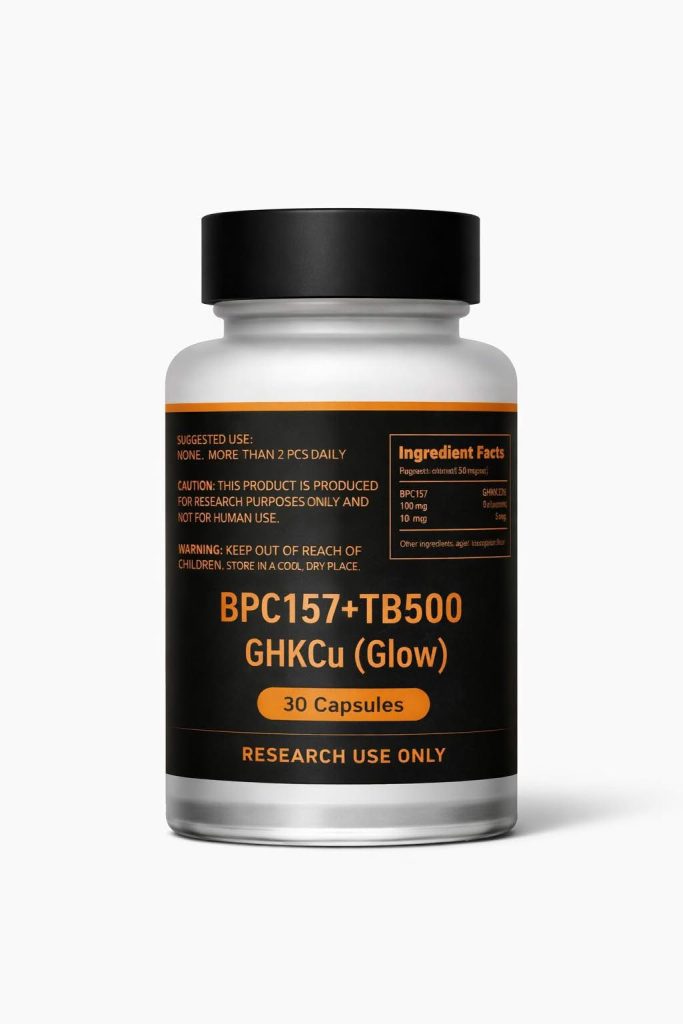
Why combine three compounds?
Skin, hair and healing are not controlled by one biological switch. Think of your body as a large construction site.
- BPC-157 is researched in relation to repair signalling and inflammation.
- GHK-Cu is studied in relation to collagen, extracellular matrix and skin biology.
- TB-500 is researched in relation to cell movement and tissue remodelling.
The theory behind a combination is easy to understand: one compound may be associated with the repair message, another with the building materials and another with how cells move through damaged tissue.
But a useful theory is not the same as proven synergy. Synergy means that combined effects are greater than the effects of each component separately. At present, robust human trials have not established that GLOW capsules produce this outcome.
The Australian Therapeutic Goods Administration (TGA) identifies BPC-157, GHK-Cu and TB-500 among unapproved peptide products that have not been assessed for safety, quality or effectiveness. The TGA’s guidance on unapproved peptide products is essential reading.
What is BPC-157?
The problem researchers are investigating
When tissue is injured, the body must coordinate inflammation, blood flow, cell migration and rebuilding. If this process becomes prolonged or poorly coordinated, recovery may be slow.
BPC-157 is a laboratory peptide fragment that has attracted interest because animal and cell research has examined its relationship with:
- Inflammatory signalling
- Blood-vessel formation
- Connective-tissue repair
- Gastrointestinal and soft-tissue models
- Cell survival and migration
A simple analogy is a site manager coordinating an emergency repair. BPC-157 is often discussed as a possible signal involved in organising activity around damaged tissue.
What the evidence actually shows
Most BPC-157 evidence remains preclinical, meaning it comes from laboratory or animal studies rather than reliable human clinical trials. Human research is limited, and there are no large, high-quality trials establishing appropriate use, effectiveness or long-term safety.
BPC-157 is also subject to Australian regulatory restrictions. It should not be treated as an ordinary beauty supplement simply because it is sold in capsule form or described online as “research-only”.
