
What is IDRA 21?
The problem researchers face in cognitive science is simple: memory is not controlled by one switch. It is more like a large communications network, with thousands of connections working together.
IDRA 21 is studied because it may influence one part of that network: the AMPA receptor.
AMPA stands for alpha-amino-3-hydroxy-5-methyl-4-isoxazolepropionic acid. That name is long, but the function is easier to understand. AMPA receptors act like fast-opening gates on nerve cells. When the neurotransmitter glutamate activates them, electrical signals can move across synapses: the junctions where nerve cells communicate.
IDRA 21 is described as a positive allosteric modulator. Rather than acting like a key that directly switches the receptor on, it binds at a separate site and changes how the receptor responds. Think of it as adjusting the sensitivity of a microphone rather than speaking into the microphone yourself.
Research suggests that IDRA 21 can reduce AMPA receptor desensitisation. In plain English, the receptor may remain responsive for longer during repeated signalling. This could strengthen excitatory communication under controlled laboratory conditions.
The short version: IDRA 21 is a research tool for studying how AMPA signalling may influence learning and memory.
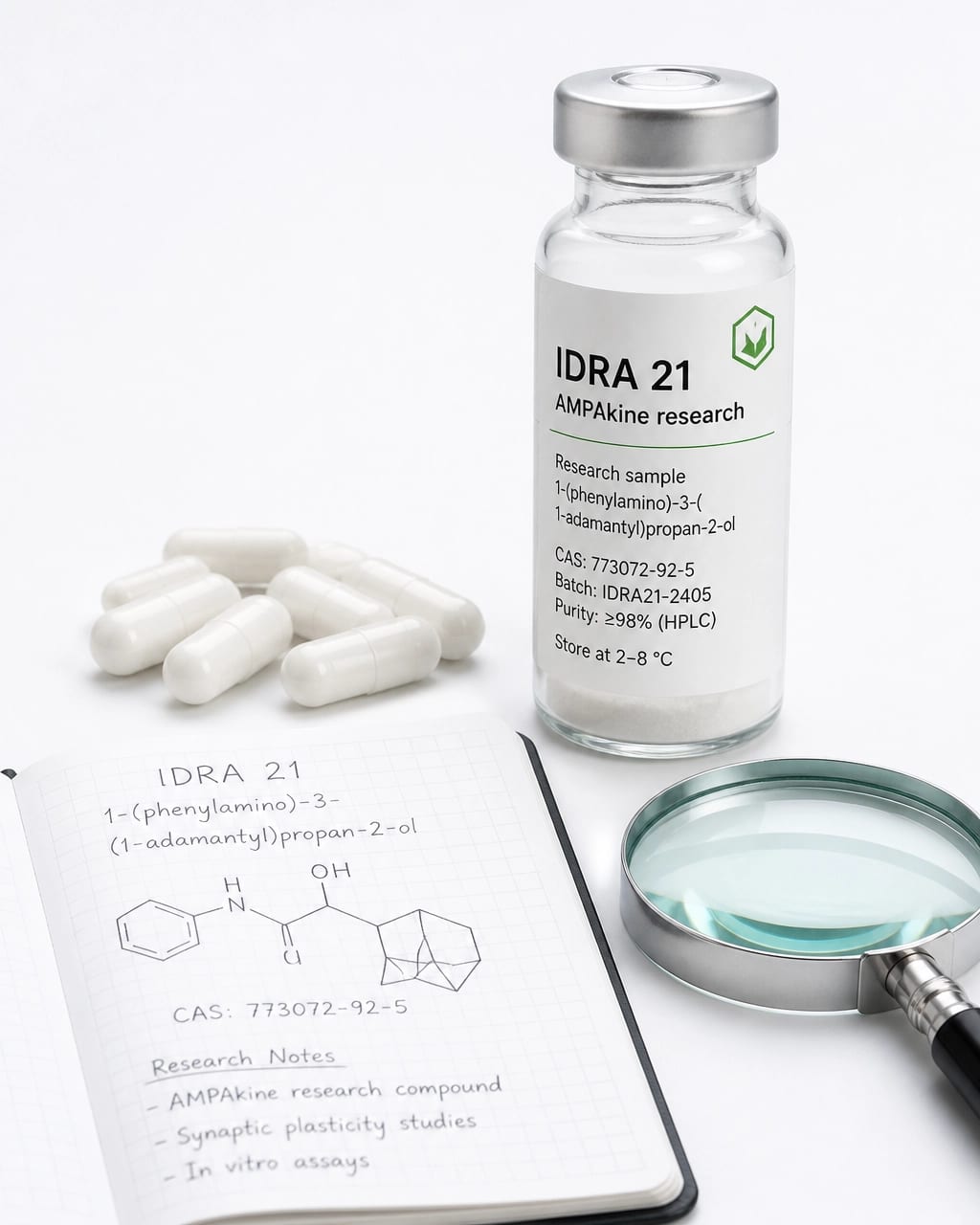
How AMPA signalling relates to memory
A common frustration in learning research is explaining why some information becomes a lasting memory while other information disappears quickly.
One important model involves long-term potentiation, or LTP. LTP is a long-lasting increase in the strength of communication between nerve cells after repeated or coordinated activity. Imagine two roads between the same towns. If traffic repeatedly travels along one route, that route may be widened and reinforced. In the brain, repeated signalling can strengthen synaptic connections in a comparable way.
The hippocampus: a brain region involved in memory processing: is one of the main areas studied in relation to LTP. AMPA receptors help carry fast excitatory signals in hippocampal circuits.
The proposed chain looks like this:
- A learning experience activates a network of neurons.
- Glutamate communicates across the synapse.
- AMPA receptors help transmit the fast signal.
- Repeated signalling may strengthen the connection.
- Stronger connections can support memory formation and retrieval.
This does not mean that increasing AMPA activity automatically creates better memory. The brain is not a computer with a simple “performance” slider. Stronger signalling can be useful in one setting and disruptive in another.
Learning depends on balance, not maximum stimulation.
