
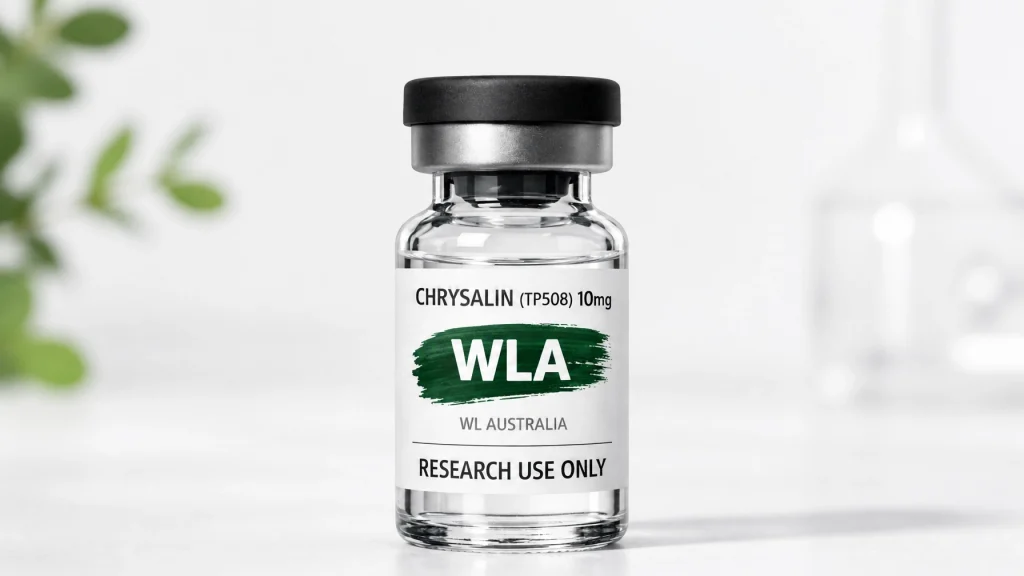
Why injuries can be slow to heal
The first frustration after an injury is often simple: you want to recover, but the tissue is not ready.
Healing is not one event. It is a sequence of overlapping stages:
- Inflammation: The body identifies damage and sends immune cells to the area.
- Proliferation: New cells, connective tissue, and small blood vessels begin forming.
- Remodelling: The repaired tissue gradually becomes stronger and more organised.
Think of the injury as a damaged road. First, the obstruction must be cleared. Next, temporary lanes are built. Finally, the road is resurfaced and tested under load.
If circulation is limited, inflammation remains excessive, or the area is stressed too soon, progress can slow. That may lead to persistent swelling, weakness, reduced mobility, or repeated injury.
Targeted peptides are studied because they may act like instructions sent to the repair crew. Rather than supplying only raw materials, they may influence cellular behaviour, including migration, proliferation, blood-vessel formation, and tissue organisation.
The goal is not to force healing. It is to understand how the body’s repair signals might be supported.
Chrysalin (TP508): supporting wound and bone repair research
Chrysalin is a synthetic 23-amino-acid peptide derived from a receptor-binding region of human prothrombin. An amino acid is a small building block used to form proteins and peptides.
Although Chrysalin is related to thrombin, it is not being discussed as a conventional clotting enzyme. Research has focused on how TP508 interacts with receptors on cells involved in tissue repair, including fibroblasts, endothelial cells, and bone-forming cells.
The problem: damaged tissue needs more than time
A wound or bone injury requires a coordinated supply chain. New tissue needs oxygen, nutrients, structural proteins, and an organised cellular response. If blood vessels do not reach the area efficiently, the repair process can stall.
The research solution: coordinate cellular repair signals
Preclinical research suggests that TP508 may support several parts of this process:
- Cell migration: Encouraging repair-related cells to move towards the injury.
- Cell proliferation: Supporting the production of new cells.
- Extracellular matrix formation: Helping create the framework around cells that gives tissue structure.
- Revascularisation: Supporting the development of new functional blood vessels.
- Bone repair signalling: Influencing early responses involved in fracture and bone-defect healing.
In one animal wound study, topical TP508 was associated with faster wound closure and increased revascularisation. In fracture models, treatment was linked with stronger callus formation and more blood vessels within the healing area.
This is promising research, but the distinction matters: animal findings do not prove that the same result will occur in people.
Human research has also been mixed. Early clinical studies examined TP508 in diabetic foot ulcers and fractures. While some wound-healing results were encouraging, a larger Phase 2b distal-radius fracture trial did not demonstrate a clear benefit over placebo. Chrysalin remains investigational and is not an approved routine therapy.
You can review the scientific background in the PubMed review of TP508 and tissue repair and the preclinical wound-healing study.
[VIDEO PLACEHOLDER : How Chrysalin (TP508) is being researched in wound and bone repair
Suggested video: an animated explanation of inflammation, cell migration, blood-vessel growth, and tissue remodelling. Include a clear “research only” disclaimer.]
