
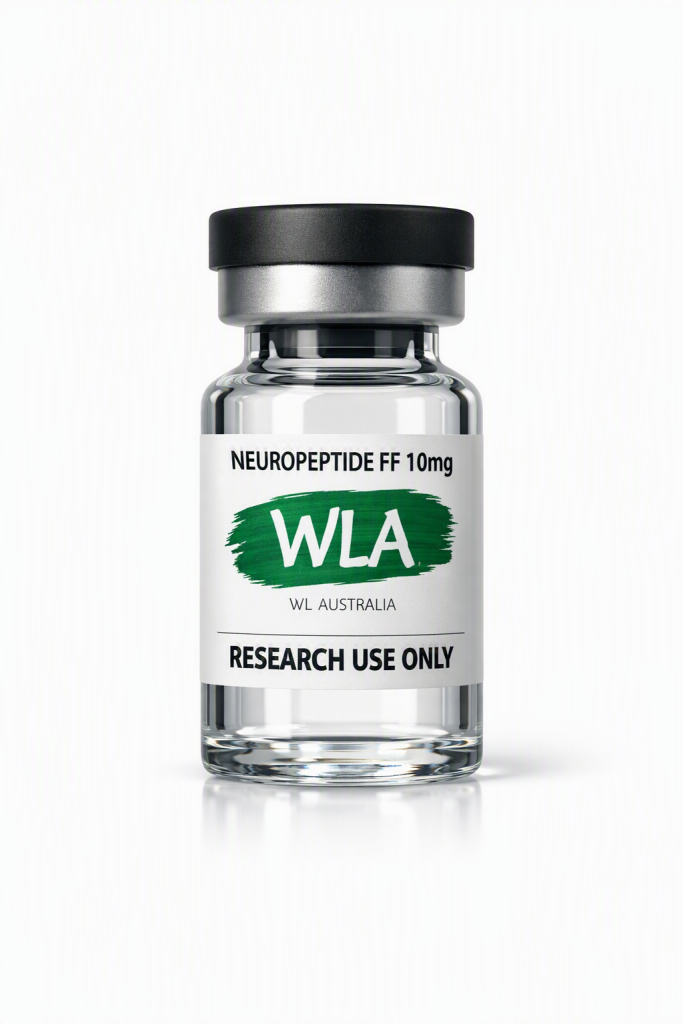
What is Neuropeptide FF?
The frustration researchers face is that pain biology is not controlled by one switch. It is more like a complex control room, with many dials influencing how strongly a signal is felt, how long it lasts and how the body responds to pain-relieving medicines.
NPFF was first isolated from bovine brain tissue in the 1980s. Its commonly cited sequence is Phe-Leu-Phe-Gln-Pro-Gln-Arg-Phe-amide, abbreviated FLFQPQRF-NH₂.
The “NH₂” indicates that the peptide is amidated at its C-terminus. Amidation is a natural chemical modification that can influence peptide stability and receptor activity.
NPFF sits within a wider RF-amide network that includes related signalling molecules involved in:
- Nociception, meaning the detection and processing of potentially harmful stimuli
- Opioid system regulation
- Energy balance and feeding
- Cardiovascular control
- Thermoregulation, or the management of body temperature
- Autonomic and neuroendocrine signalling
Think of the RF-amide family as a communications team. Different members deliver different messages, but they often work in overlapping biological circuits.
Core principle: NPFF is best understood as a regulator of signalling, not as a simple “pain-off” peptide.
NPFF1 and NPFF2: Two receptor gateways
A major research challenge is determining where NPFF acts and which receptor is responsible. NPFF primarily signals through two G-protein-coupled receptors (GPCRs):
- NPFF1, also called NPFFR1
- NPFF2, also called NPFFR2
GPCRs are cell-surface receptors that act like security gates. When a signalling molecule fits the receptor, the gate changes shape and activates internal messenger systems.
Both NPFF1 and NPFF2 are commonly associated with Gi/o proteins, which can reduce adenylyl cyclase activity and alter cyclic adenosine monophosphate (cAMP) signalling. In plain English, the receptor can adjust how easily a nerve cell becomes active.
| Research feature | NPFF1 | NPFF2 |
|---|---|---|
| Alternative name | NPFFR1 | NPFFR2 |
| Receptor class | G-protein-coupled receptor | G-protein-coupled receptor |
| Common signalling association | Gi/o-mediated pathways | Gi/o-mediated pathways |
| Research focus | Pain, feeding, energy balance, stress and opioid responses | Pain, cardiovascular regulation and thermogenesis |
| Key limitation | Effects vary by tissue and experimental model | Effects vary by tissue and experimental model |
The solution to oversimplification is to look at receptor subtype, brain region, dose, timing and route of administration together. The same peptide may produce different outcomes in different biological settings.
That is why NPFF research requires careful experimental design rather than broad claims.