
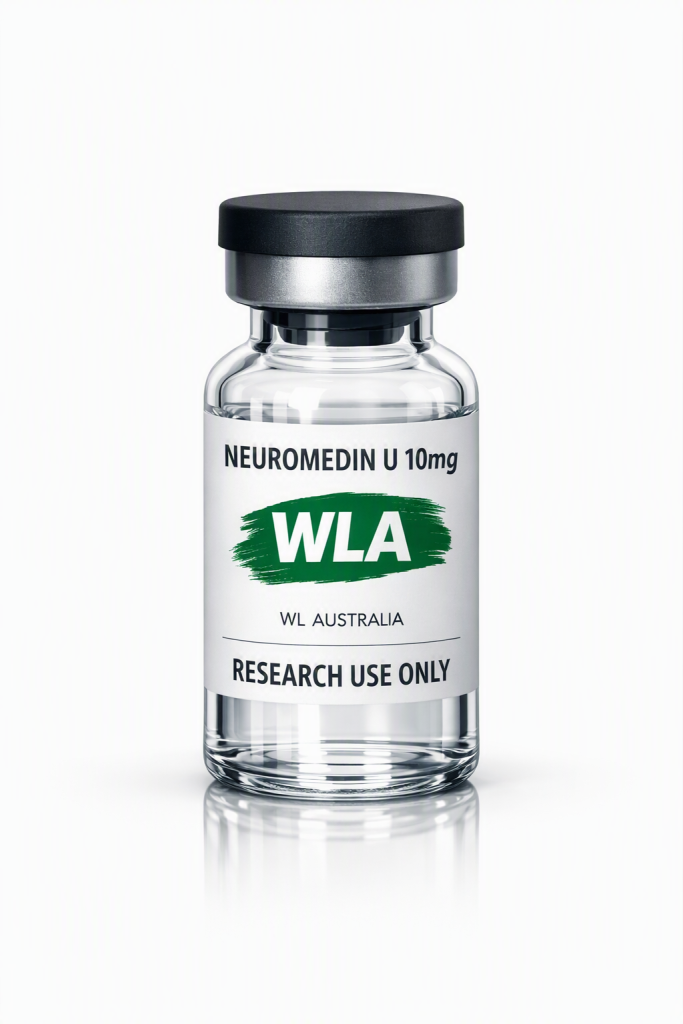
What is Neuromedin U?
The problem: the name sounds obscure, but the biology is highly practical
NMU was first isolated in 1985 from porcine spinal cord by researchers studying substances that caused powerful contractions in rat uterine tissue.
That unusual activity gave the peptide its name:
- “Neuromedin” refers to its classification among neuropeptides.
- “U” refers to its strong uterus-contracting, or uterotonic, activity.
Think of the original discovery as finding a new electrical signal while testing a motor. Researchers noticed the signal because it made the motor move. Later, they discovered that the same signal was involved in several other systems.
NMU exists mainly in two forms:
- NMU-8: an eight-amino-acid fragment.
- NMU-25: a longer 25-amino-acid form in humans.
The shorter NMU-8 sequence represents the biologically important C-terminal region of the longer peptide. In simple terms, NMU-8 contains much of the “business end” needed to activate its receptors.

Short summary: NMU was named for uterine contraction, but its research profile now extends across appetite, metabolism, gut function, stress and pain biology.
NMUR1 and NMUR2: two receptors, two main control rooms
The problem: one peptide can produce different effects in different tissues
NMU works through two main G-protein-coupled receptors, or GPCRs. GPCRs are cell-surface communication switches that receive a chemical message and pass instructions into the cell.
The two main NMU receptors are:
| Receptor | Main location | Research role |
|---|---|---|
| NMUR1 | Peripheral tissues, especially the gastrointestinal tract, smooth muscle and immune cells | Gut motility, smooth muscle contraction, intestinal signalling and immune regulation |
| NMUR2 | Central nervous system, particularly hypothalamic and stress-related brain regions | Appetite, energy expenditure, stress responses and pain-related signalling |
A useful analogy is a company with two offices:
- NMUR1 is the field office. It is positioned in the gut and other peripheral tissues, where it helps manage movement and local functions.
- NMUR2 is the headquarters. It is concentrated in the brain, where it helps coordinate appetite, energy output and stress circuits.
This division is not absolute. Biological systems overlap, and NMU can influence both central and peripheral pathways. However, the distinction helps explain why researchers study NMUR1 and NMUR2 separately.
The solution: when assessing NMU research, always ask two questions: where is the receptor located, and what biological job is it performing there?
