
The Foundation: What are Anxiolytic Peptides?
To understand Selank and Adalank, consider your brain’s inhibitory system: the “brakes” of your nervous system. These brakes are primarily managed by a neurotransmitter called GABA (Gamma-Aminobutyric Acid). When you are stressed, your “accelerator” (glutamate) is floored, and your “brakes” struggle to keep up.
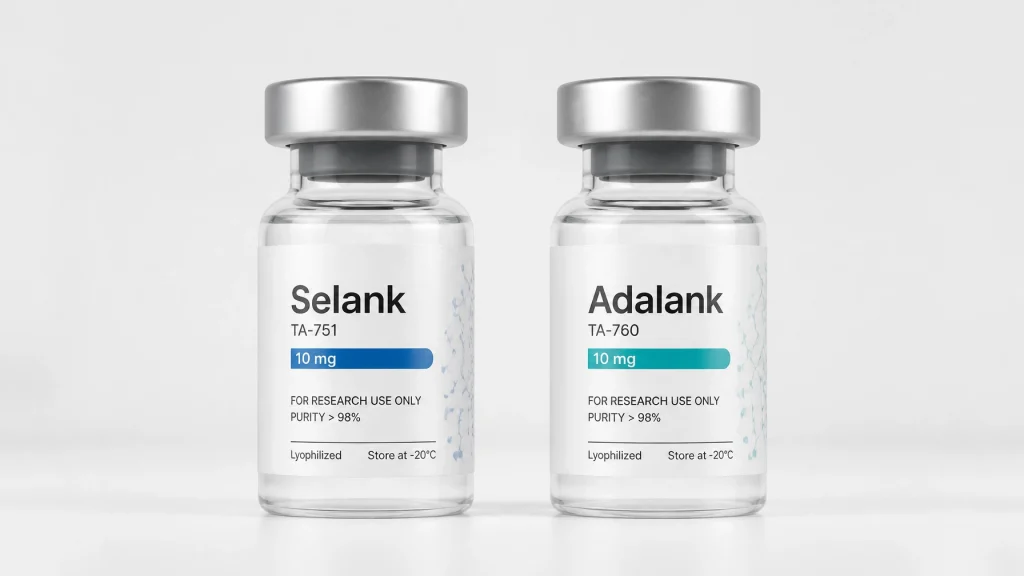
Selank is a synthetic analog of a naturally occurring peptide in the human body called Tuftsin. Tuftsin is an essential part of your immune system, but scientists discovered that by slightly altering its structure, they could create a compound that talks directly to the brain’s emotional centers.
Adalank, on the other hand, is the “high-performance” version of Selank. It takes the original Selank blueprint and adds two chemical “attachments”: an acetyl group and an amidate group. Think of this as giving a standard car an aerodynamic body kit and a larger fuel tank; the core engine is the same, but the performance is significantly enhanced.
Focus on this core principle: both peptides are designed to act as a GABAergic modulator. They don’t force the brakes on like a sedative; they simply make the brakes more responsive when you need them.

The Mechanism: How They Work in Your Brain
Both Selank and Adalank operate through a multi-pronged strategy to restore internal balance. If your brain is a sports team, these peptides act as the head coach, coordinating different players to ensure the game doesn’t descend into chaos.
- GABA Modulation: As mentioned, they enhance the efficiency of GABA receptors. Unlike benzodiazepines, which can cause “brain fog” and dependence, these peptides are far more subtle. They help you stay calm while keeping your “engine” running at peak performance.
- BDNF Upregulation: Both compounds stimulate the release of Brain-Derived Neurotrophic Factor (BDNF). BDNF is essentially “fertilizer for the brain.” It helps repair damaged neurons and encourages the growth of new ones, particularly in the hippocampus: the area responsible for memory and emotional regulation.
- Neurotransmitter Balancing: They influence the levels of serotonin and dopamine. By smoothing out the peaks and valleys of these chemicals, the peptides provide a mood-stabilizing effect that feels natural rather than artificial.
