
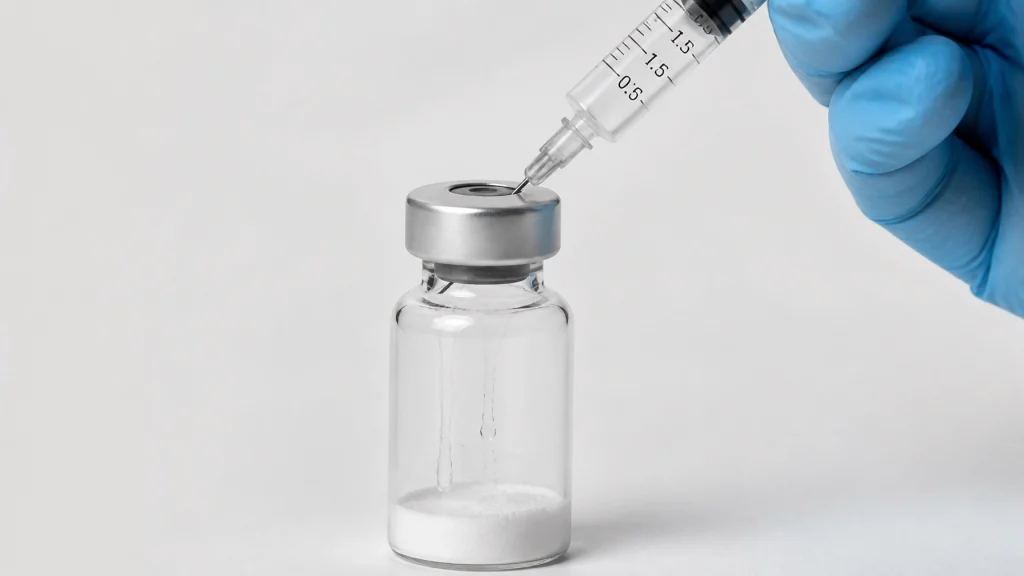
You have secured your research materials, prepared your sterile workspace, and are ready to transition your peptides from their stable, freeze-dried (lyophilized) state into a liquid solution. It seems simple enough: add water, and you’re done. However, this is the exact moment where most researchers: both novice and experienced: unintentionally compromise the integrity of their sequence.
In this third installment of our Advanced Reconstitution & Stability Series, you will learn why the physical method of mixing is just as critical as the chemical purity of your solvent. Consider this: if a peptide is a precision-engineered car engine, reconstitution is the process of putting the oil in. Do it too fast or too aggressively, and you risk mechanical failure before the engine even turns over.
The Physics of Fragility: Why Shaking is the Enemy
To understand why we never shake a vial, you must first understand Shear Force. Imagine a delicate piece of origami. If you place it in a jar and shake it violently, the paper will crumple, tear, and lose its specific shape. Peptides are essentially molecular origami. They rely on a very specific three-dimensional shape: called “folding”: to interact with receptors in your biology.
When you shake a vial, you create turbulent flow. This high-velocity movement creates mechanical stress that can literally pull the peptide chains apart or cause them to “unfold” (denature). Furthermore, shaking introduces millions of tiny air bubbles. At the surface of every air bubble, the surface tension is high enough to attract and trap peptide molecules, causing them to clump together in a process called aggregation.
