
What is Apelin-13?
The problem: one peptide family, many names
The apelin system can be confusing because the body produces several related peptide fragments from a larger precursor molecule called preproapelin.
Researchers commonly discuss:
- Apelin-36
- Apelin-17
- Apelin-13
- [Pyr¹]-apelin-13, a pyroglutamyl form with a modified first amino acid
These peptides share a common origin but do not behave identically. Their stability, distribution and receptor activity can differ, rather like different keys cut from the same original design.
The solution: focus on the most active short form
Apelin-13 draws particular attention because it is a small, potent fragment with strong activity at the APJ/APLNR receptor. It is frequently studied in cardiovascular experiments because of its effects on:
- Vascular tone
- Cardiac contractility
- Blood pressure regulation
- Ischaemia and reperfusion injury
- Glucose utilisation
- Insulin sensitivity
- Brain and blood-brain barrier protection
Apelin was first identified as the endogenous ligand, the body’s natural activating messenger, for the previously “orphan” APJ receptor. The term orphan receptor means researchers had identified the receptor before they knew which natural molecule activated it.
In short: Apelin-13 helps researchers study how one receptor can coordinate heart, blood-vessel and metabolic signals.
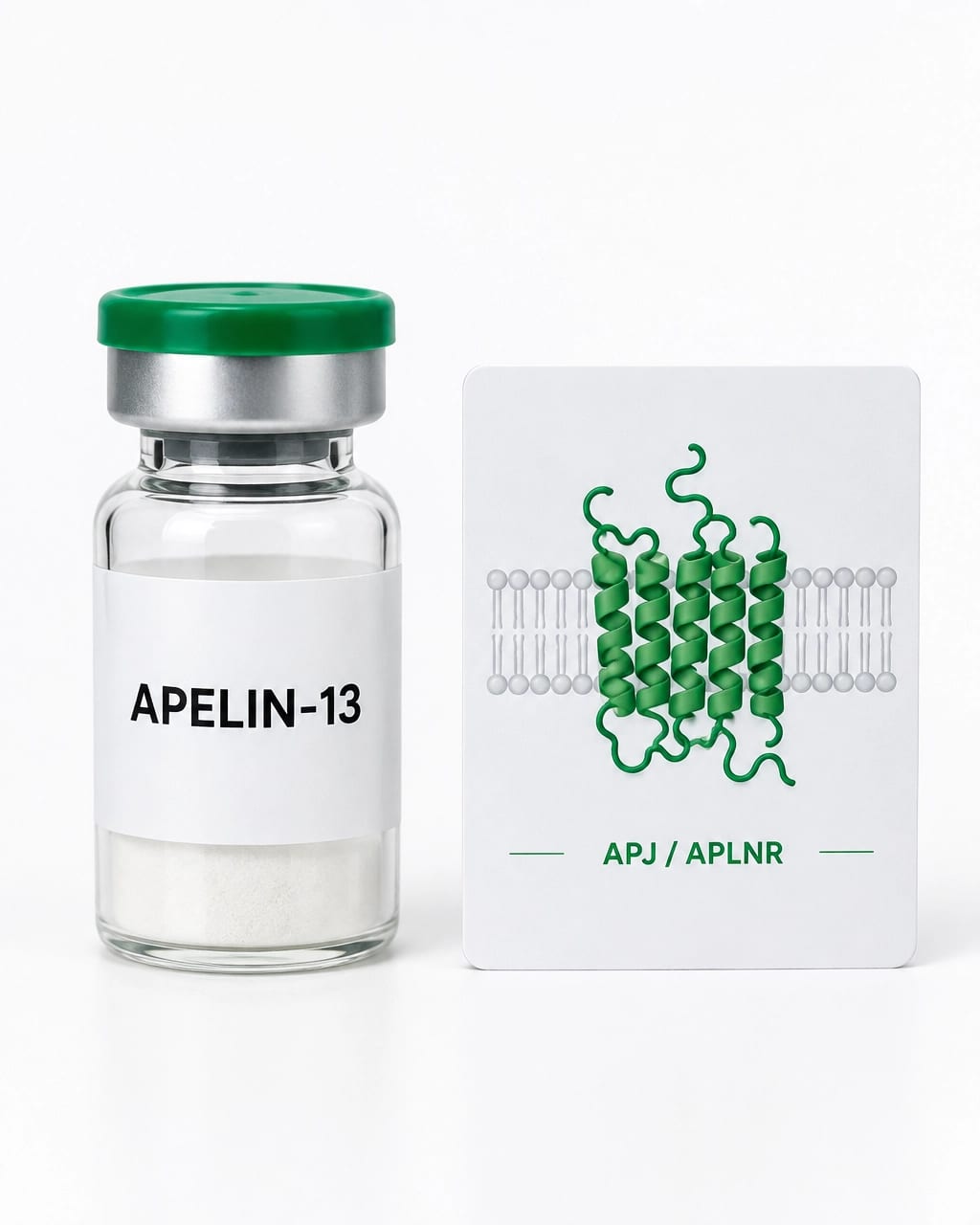
The APJ receptor: a cardiovascular system with two faces
The problem: cardiovascular signalling is rarely one-directional
Many people expect a biological pathway to be either protective or harmful. The APJ system does not fit neatly into that category.
In healthy experimental settings, Apelin-13 signalling may support:
- Nitric oxide-dependent vasodilation
- Improved blood flow
- Increased cardiac contractility
- Lower peripheral vascular resistance
- Better tissue resilience during low-oxygen stress
However, the same pathway can behave differently in disease models, altered vascular beds or abnormal tissue environments. Apelin/APLNR signalling has also been linked to vascular remodelling, angiogenesis and disease-related changes. This is why researchers describe the receptor as context-dependent.
The solution: study the whole system, not one claim
The APJ receptor is unusual because it sits close to several major control systems, including the renin-angiotensin system, or RAS. RAS helps regulate blood pressure, vascular constriction, kidney function and fluid balance.
Apelin/APLNR signalling is often described as a counter-regulatory partner to parts of the RAS. A simple analogy is a car with both an accelerator and a braking system. Angiotensin II acting through the AT₁ receptor can promote vasoconstriction and other pressure-raising effects, while apelin signalling may support vasodilation and cardiac performance.
That analogy is useful, but it is not a complete explanation. Apelin-13 is not a replacement for blood-pressure medication, and it should not be treated as a natural RAS blocker. Human and animal findings vary according to dose, timing, species and disease state.
For a detailed comparison of cardiovascular peptide research, explore The Heart-Guard: Exploring the Cardioprotective Power of Hexarelin and Cardiogen: Keeping Your Heart in the Right Rhythm.
Video placeholder: Apelin-13 and the APJ/APLNR receptor
Insert an educational video explaining receptor signalling, vasodilation and the relationship between the apelin system and the renin-angiotensin system.
