
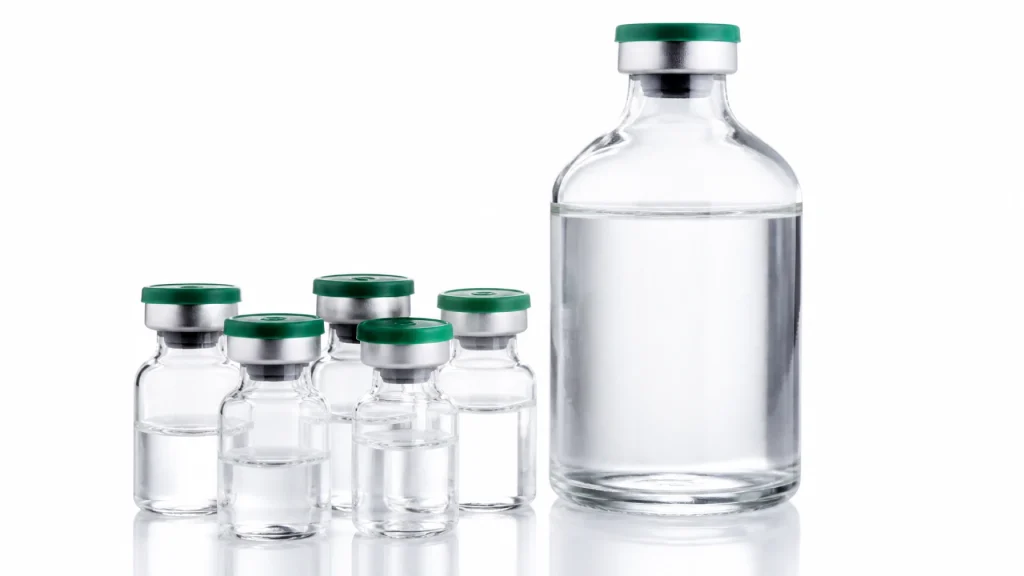
The Problem: Longevity vs. Purity
A common frustration for many researchers is seeing a peptide solution go “cloudy” or lose its “kick” before the vial is empty. This often happens because the water choice didn’t match the intended use.
Bacteriostatic Water (BAC)
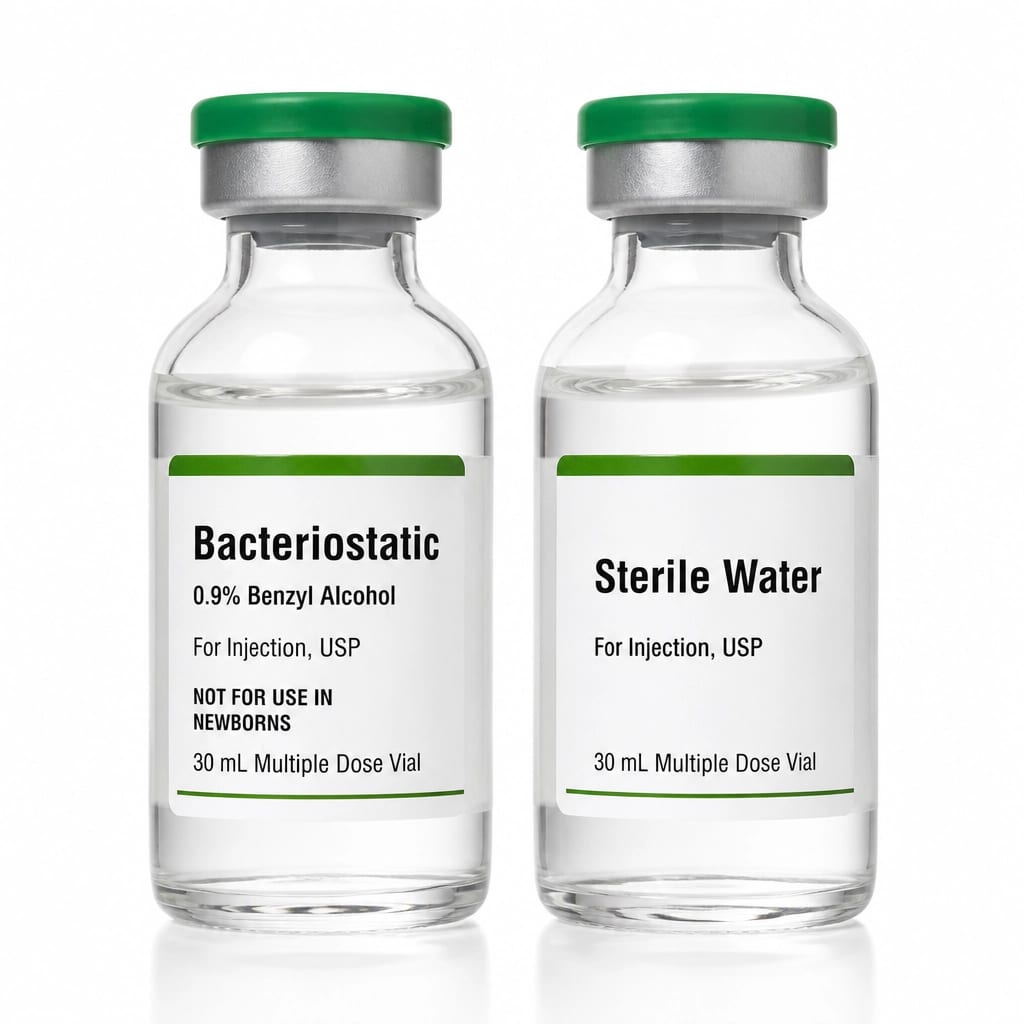
Bacteriostatic Water is sterile water containing 0.9% Benzyl Alcohol. Think of Benzyl Alcohol as a security guard for your vial. It doesn’t necessarily kill every germ on contact, but it stops them from “breeding” or multiplying.
- Focus on: Multi-dose vials. If you plan to draw from the same vial over 2 to 4 weeks, BAC water is your standard.
- Shelf Life: Once opened, a vial of BAC water is typically reliable for about 28 days if stored correctly.
- The “Burn”: Because of the alcohol, some users report a slight stinging sensation at the injection site. This is the trade-off for multi-day safety.
Sterile Water for Injection (SWFI)
Sterile Water is exactly what it sounds like: H2O that has been sterilized but contains no preservatives.
- Consider this: Single-use only. Once you pop the top, the “security guard” isn’t there. If a single bacterium enters the vial, it has a free pass to take over.
- The Benefit: It is generally gentler on the peptide’s delicate structure and doesn’t cause the “benzyl sting.”
- The Risk: If you don’t use the entire reconstituted vial immediately, you must discard the rest. Storing reconstituted peptides in plain sterile water for more than a few hours is a recipe for contamination.
The pH Factor: Why Acidity Matters
Peptides are like zippers. For the zipper to work, the teeth need to line up perfectly. If the environment is too acidic or too basic (alkaline), those “teeth” (amino acids) can warp, preventing the peptide from folding into its active shape. This is called denaturation.
Most commercial waters have a pH range:
- Sterile Water: Usually pH 5.0 to 7.0.
- BAC Water: Usually pH 4.5 to 7.0.
While these ranges are “near neutral,” even a small slide toward the acidic or basic side can change how well a peptide dissolves (solubility) and how long it stays active (stability).
The Synergy of Stability
Most synthetic peptides, like those found in our bioregulators collection, prefer a slightly acidic environment for long-term storage. When the pH is around 5.0 to 6.0, the peptide is essentially “in hibernation,” resistant to breaking down. However, for the best comfort during use, a neutral pH (around 7.0 to 7.4) is ideal.
