
What is Enterogen?
The problem: gastrointestinal research can be difficult to organise
The digestive tract is not one simple tube. It is more like a large industrial site with several departments:
- The stomach manages acidity and early digestion.
- The small intestine absorbs nutrients.
- The colon manages water, fermentation and waste.
- The mucosal barrier acts like a security fence between the gut contents and the underlying tissue.
- The liver processes many nutrients and compounds arriving through the portal circulation.
A disruption in one area can affect the others. That is why gastrointestinal studies often examine barrier integrity, epithelial renewal, inflammation and nutrient handling together.
The solution: study Enterogen as a tissue-focused research tool
Enterogen is described by the product listing as a short-chain peptide bioregulator associated with gastrointestinal and intestinal tissues. A peptide is a short chain of amino acids: the same basic building blocks used to make proteins.
The bioregulator concept is sometimes compared with a project manager at a construction site. It does not replace the bricks, workers or tools. Instead, it is studied for whether it can influence cellular instructions involved in tissue maintenance and renewal.
However, this is a research hypothesis, not a confirmed clinical outcome.
Explore the WL Australia bioregulator category
Enterogen dosage: what the 10mg label means
The problem: confusing product quantity with a personal dose
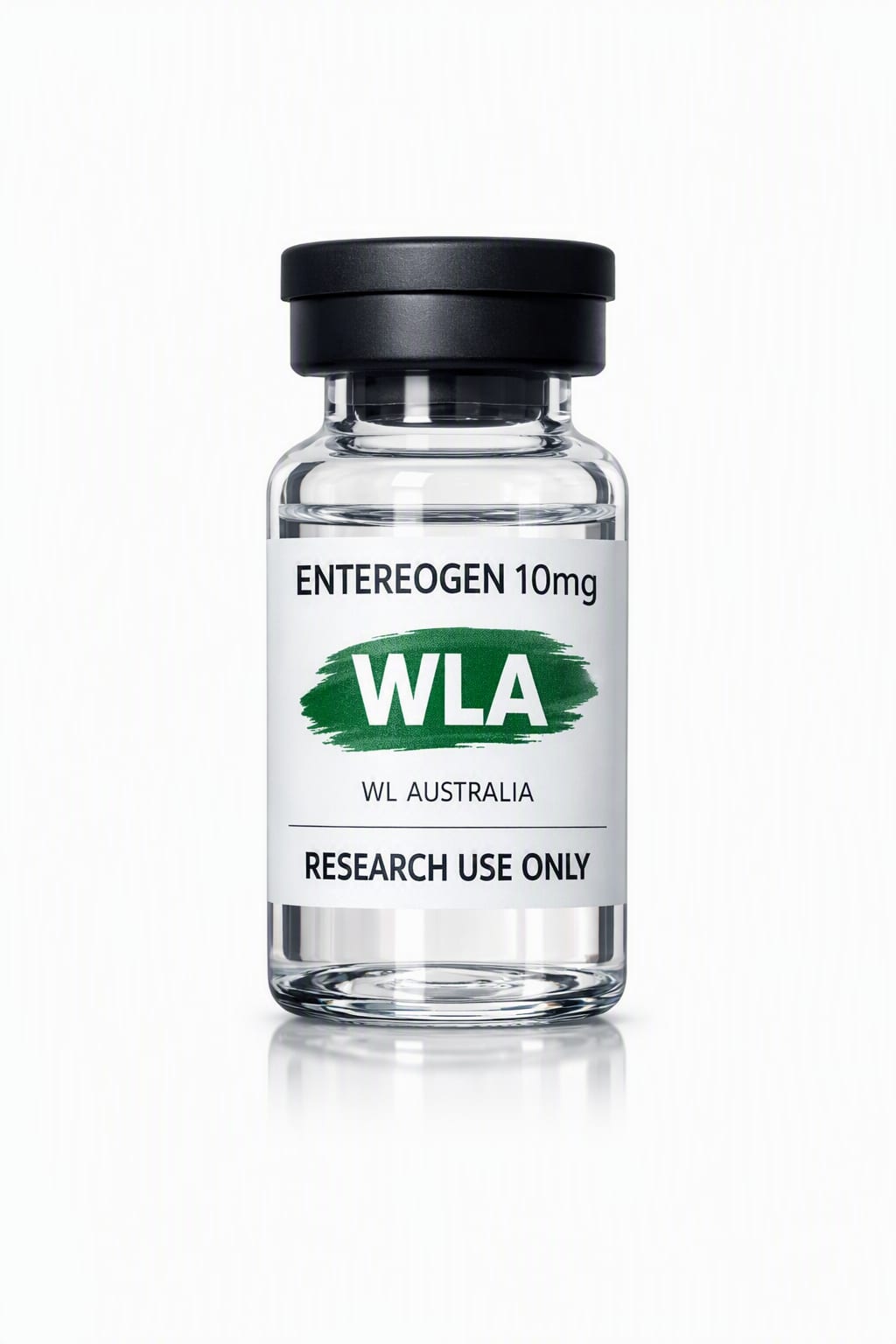
A bottle labelled 10mg tells you the total stated amount in the product presentation. It does not tell you:
- How much a person should take
- How often it should be taken
- How long it should be used
- Whether it is suitable for oral use
- Whether it is safe with medicines or medical conditions
This is similar to seeing “5 litres” printed on a fuel container. The number describes the container’s contents. It does not tell you whether that fuel belongs in your car, how far it will take you or whether it meets your engine’s specifications.
The solution: use the label as an inventory reference only
For laboratory planning, the 10mg figure may be recorded as a study-material quantity. A research team might document:
| Item | What it tells you |
|---|---|
| Product name | Enterogen |
| Listed amount | 10mg |
| Product status | Research chemical only |
| Intended context | Laboratory or controlled research |
| Human dosage | Not established or provided |
| Clinical indication | None approved |
Do not convert the 10mg listing into a daily capsule dose. There is no validated human dosing protocol for this product, and presenting one could create a serious safety risk.
You can view the current listing here: Enterogen 10mg.
