

The “Crop Rotation” Strategy: Why Site Selection Matters
Imagine a farmer who plants the same crop in the exact same patch of soil year after year. Eventually, the soil becomes depleted, hard, and unproductive. Your subcutaneous tissue: the layer of fat just beneath the skin: is your “soil.” If you repeatedly inject into the same square centimeter, you risk developing lipohypertrophy (localized fatty lumps) or scar tissue.
Focus on this: Scar tissue acts like a clogged filter in a car’s fuel line. Once it forms, the absorption rate of your peptides becomes unpredictable. What was once a high-bioavailability protocol becomes a guessing game. To avoid this, you must implement a “crop rotation” strategy.
Recommended Injection Areas
For most peptide research involving consumables and subcutaneous administration, the following zones are your primary targets:
| Zone | Description | Notes |
|---|---|---|
| Abdomen | 2 inches away from the navel | The most common site; provides consistent absorption. |
| Outer Thighs | Middle third of the thigh | Best for researchers who prefer a firmer site. |
| Upper Glutes | The “love handle” area | Ideal for larger volume research or rotating away from the torso. |
| Back of Arms | Tricep area | Usually requires an assistant to ensure the correct depth. |
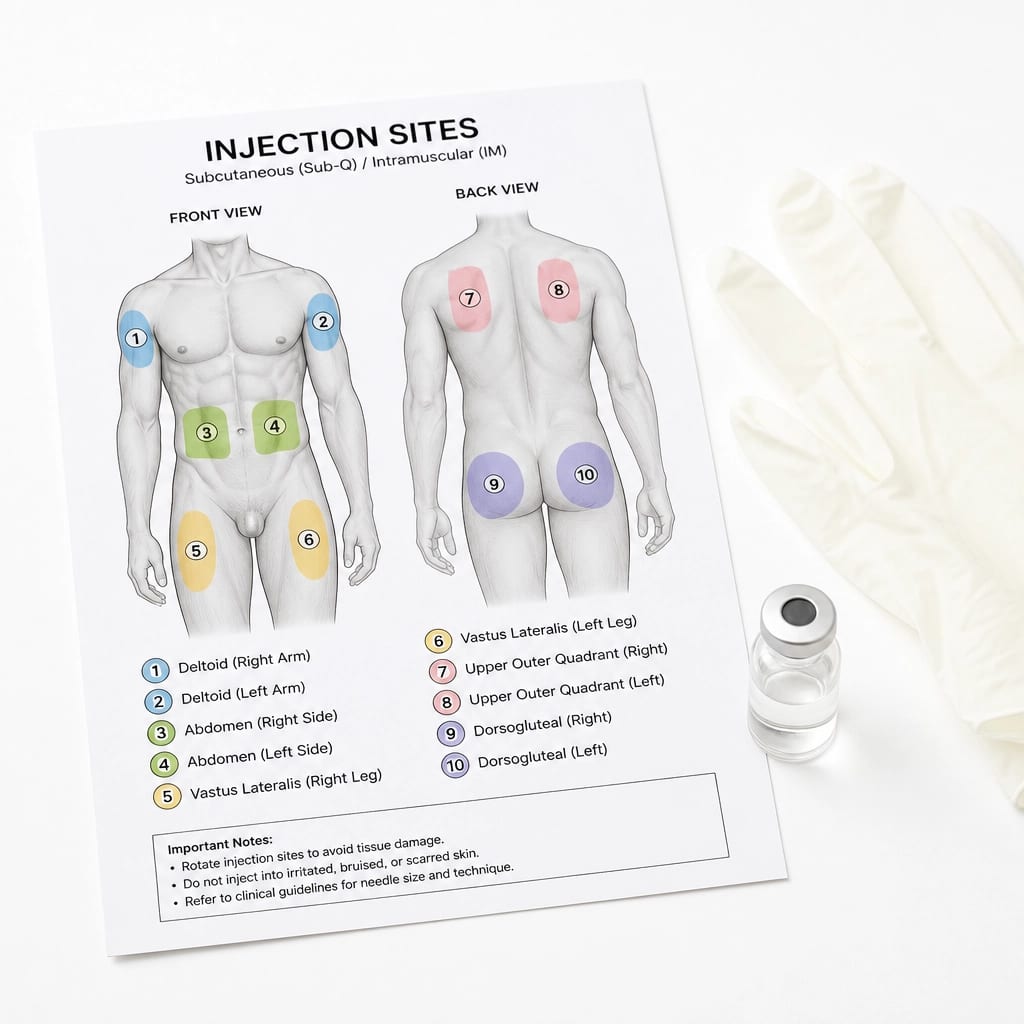
Mapping Your Research: The 7-Day Rotation Rule
You will learn that the “Golden Rule” of site rotation is the 7-Day Buffer. Consider your skin like a zipper; if you pull it too hard in one spot too often, the teeth will eventually fail to align. You should never return to the exact same injection point (within 1 inch) for at least seven days.
Practical Application: Divide your abdomen into four quadrants (Upper Left, Upper Right, Lower Left, Lower Right). Rotate through these quadrants, then move to the thighs or glutes. By the time you return to the first quadrant, the “soil” has had a full week to recover and oxygenate.
