
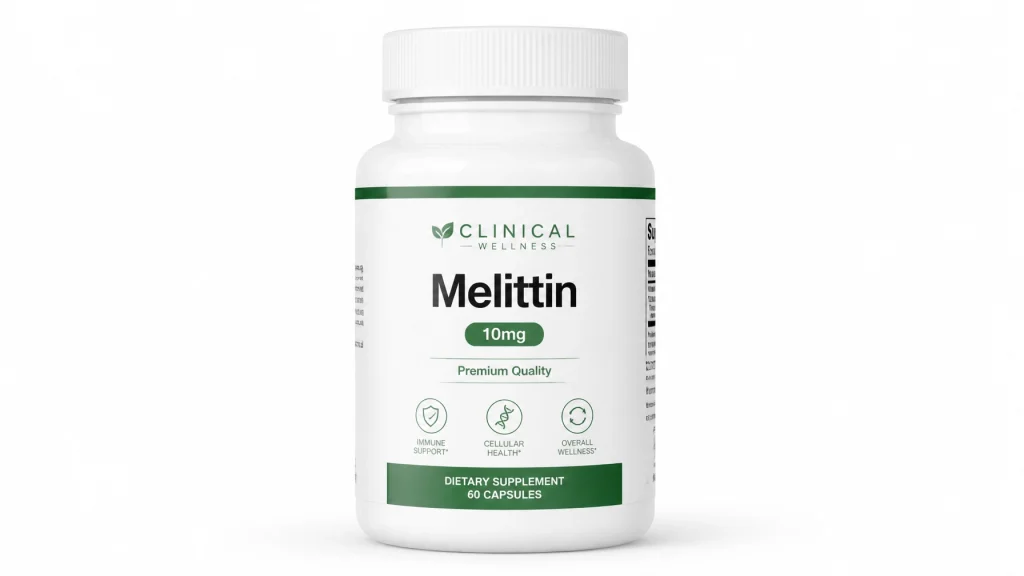
1. Foundational Architecture: What is Melittin?
The Problem: Biological Resilience vs. Microbial Armor
Pathogenic bacteria and inflammatory pathways often possess robust defenses that render conventional interventions sluggish or ineffective. When microbes construct resilient biofilms or when the immune system gets trapped in a perpetual loop of irritation, your biological systems experience gridlock.
The Solution: The 26-Amino-Acid Molecular Key
You can think of Melittin as a master construction crew equipped with a specialized molecular key. Structurally, it is a 26-amino-acid, amphipathic (possessing both hydrophilic and hydrophobic regions), cationic peptide comprising roughly 40–50% of dry bee venom.
- Hydrophobic Tail: Drives insertion directly into lipid bilayers.
- Cationic Head: Attracts negatively charged cellular surfaces.
- Synergy: This dual nature allows Melittin to act with devastating precision against unwanted cellular targets.

Focus on the core principle: Optimization relies on precision. Melittin demonstrates that natural templates can achieve extraordinary structural integration when engineered correctly.
2. Antimicrobial Powerhouse: Breaching Resistant Strains
The Problem: Superbug Resistance and Biofilm Barriers
Traditional antibiotics face a mounting crisis as drug-resistant strains: such as methicillin-resistant Staphylococcus aureus (MRSA): build impenetrable polysaccharide fortresses known as biofilms. These barriers function like concrete walls around a medieval city, blocking standard pharmacological agents.
The Solution: Pore Formation and Triple-Action Disruption
Consider Melittin like a demolition team using targeted explosive charges. When introduced to microbial environments, Melittin exhibits a triple-action profile: broad-spectrum antibacterial action, anti-biofilm eradication, and quorum-sensing inhibition.
- Membrane Insertion: Melittin binds to microbial membranes, inserting itself like a wedge into wood.
- Pore Assembly: It aggregates to form toroidal pores, causing rapid cytoplasmic leakage and cellular lysis.
- Biofilm Penetration: It actively dismantles mature biofilms, exposing entrenched bacterial colonies to clearance.
| Feature | Traditional Antibiotics | Melittin Peptide |
|---|---|---|
| Target Mechanism | Inhibits specific enzymatic synthesis (e.g., cell wall or protein synthesis) | Physical disruption of lipid bilayers and pore formation |
| Biofilm Efficacy | Often blocked by extracellular polymeric substances | High penetration and eradication capacity |
| Resistance Risk | High evolutionary pressure leading to acquired resistance | Low incidence of direct resistance due to physical membrane lysis |
For complementary immune support strategies, consider reviewing our guides on Thymopentin 20mg and metabolic health optimization via Svetinorm 20mg.
[Video Placeholder: Watch our expert visual breakdown on Melittin membrane pore formation and bacterial lysis mechanics.]
