
1. The Core Dilemma: Brute Force vs. Precision Signaling
The Problem: Uncontrolled Toxicity vs. High Potency
In early-stage in-vitro studies, researchers often encounter a frustrating roadblock: a peptide exhibits remarkable biological potency, but its collateral damage makes experimental control nearly impossible. Think of it like running a high-performance car engine without a cooling system: the raw power is undeniable, but the system quickly self-destructs.
The Solution: Mechanistic Differentiation and Optimization
To resolve this, you must analyze how specific amino acid sequences interact with biological membranes and receptors. Melittin acts like a heavy construction demolition ball, while Dermorphin operates like a master locksmith picking a specific security gate.
- Melittin: Derived primarily from honeybee (Apis mellifera) venom: comprising roughly 40–60% of the venom’s dry weight: this 26-amino-acid cationic amphipathic peptide folds into an alpha-helix when encountering lipid bilayers. It creates destructive pores, disrupting cell membranes.
- Dermorphin: Isolated from South American tree frog skin secretions, this heptapeptide (7 amino acids) targets the μ-opioid receptor (MOR: a G-protein-coupled receptor governing central nervous system pain pathways) with extreme selectivity and potency.
Key Takeaway: Optimization requires balancing raw potency with structural selectivity to ensure reproducible experimental outcomes.
2. Molecular Architecture and Cellular Targets
To evaluate these agents accurately, you must look beneath the surface at their primary structures.
Understanding the Terminology
- Amphipathic Peptide: A molecule containing both hydrophilic (water-loving) and hydrophobic (lipid-loving) regions, allowing it to interface seamlessly with cell membranes.
- Phospholipase A₂ (PLA₂): An enzyme activated or influenced by venom components that hydrolyzes membrane phospholipids into inflammatory mediators.
- μ-Opioid Receptor (MOR): The primary membrane receptor in the brain and spinal cord responsible for mediating analgesic (pain-relieving) responses.

Comparative Structural Breakdown
| Feature | Melittin | Dermorphin |
|---|---|---|
| Natural Source | Honeybee venom (Apis mellifera) | South American tree frog (Phyllomedusa species) |
| Structure Length | 26 amino acids (linear cationic) | 7 amino acids (with an unusual D-alanine residue) |
| Primary Target | Lipid bilayer membranes (pore formation) | μ-Opioid Receptor (MOR) agonist |
| Primary Effect | Cell lysis, membrane disruption, nociception | Ultra-potent central nervous system analgesia |
| Primary Research Focus | Antimicrobial, antiviral, antitumor, and anti-inflammatory pathways | Biased agonism and pain management pharmacology |
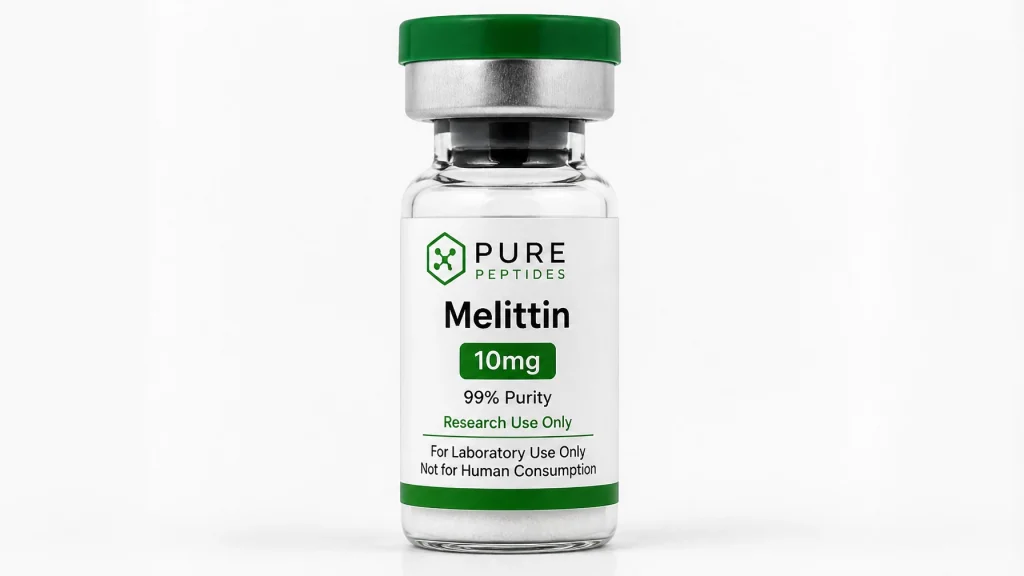
Focus on: When designing your laboratory protocols, always verify the purity and amino acid sequencing of your compounds. For researchers exploring related immunomodulatory or regulatory peptides, reviewing options such as Melittin 10mg, Alloferon-1 10mg, and Opiorphin 10mg provides a comprehensive view of peptide diversity.
