
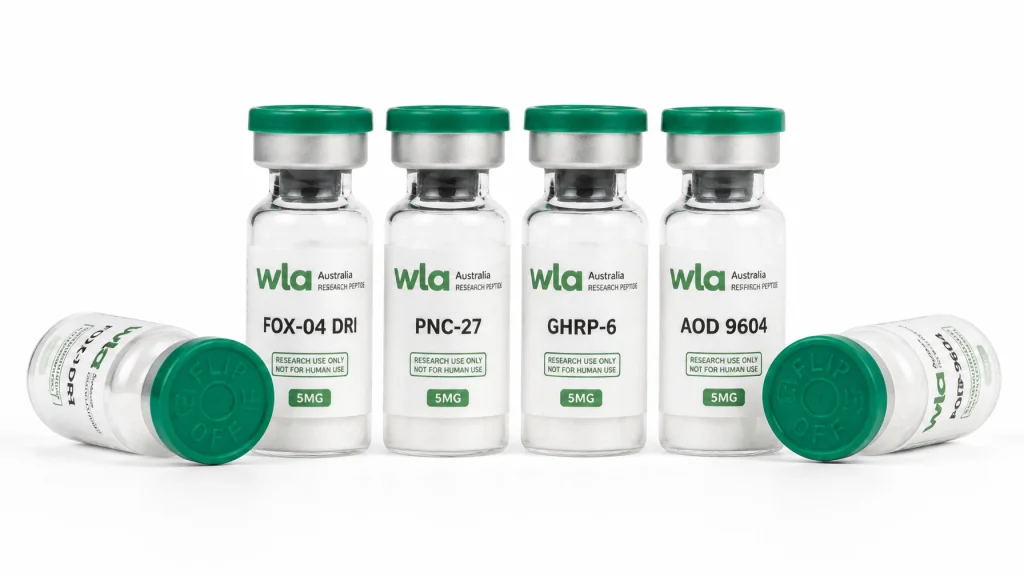
FOX-04 Dri: The Cellular Janitor
Focus on: Senescence and Cellular Aging
As we age, some of our cells stop dividing but refuse to die. These are known as “senescent cells,” or more colloquially, “zombie cells.” They don’t contribute to the body’s function; instead, they sit there secreting inflammatory signals that damage neighboring healthy cells.
The Problem: Your body’s natural cleanup crew (apoptosis) has been locked out. The “zombie” cells use a protein called FOXO4 to hold another protein, p53, hostage. As long as p53 is tied up, the cell cannot trigger its own “self-destruct” sequence.
The Solution: FOX-04 Dri (available in 5mg and 10mg) acts like a cellular janitor with a master key. It is a “D-retro-inverso” peptide designed to mimic the binding site where FOXO4 grabs p53.
How it works:
- Intervention: FOX-04 Dri enters the senescent cell.
- Disruption: It tricks the FOXO4 protein into letting go of p53.
- Apoptosis: Once freed, p53 migrates to the mitochondria and pulls the “eject lever,” causing the zombie cell to finally expire and be cleared away.
Research Insight: By clearing these inflammatory anchors, research suggests a “reset” of the local tissue environment, potentially improving recovery times and systemic vitality.

PNC-27: The Precision Locksmith
Focus on: Abnormal Cell Targeting
If FOX-04 is the janitor, PNC-27 is the precision locksmith. This peptide was developed to identify and interact with specific markers found almost exclusively on the membranes of abnormal or cancer-research cell lines.
The Problem: Distinguishing between a healthy cell and a rogue cell is the greatest challenge in modern therapeutics.
The Solution: PNC-27 (10mg) contains a specific sequence that binds to HDM2 (a protein often overexpressed on the surface of abnormal cells).
The Mechanism:
Consider this like a “search and rescue” beacon. PNC-27 doesn’t just bind; it creates a physical hole (a pore) in the membrane of the target cell.
- Step 1: The peptide identifies the HDM2 marker on the cell wall.
- Step 2: It anchors itself and begins to form a transmembrane pore.
- Step 3: The cell undergoes necrosis (rapid lysis) because it can no longer maintain its internal pressure.
Because healthy cells typically do not express HDM2 on their outer membranes, the “locksmith” simply walks past them, leaving the “good” doors untouched.
