Lifting the Brake: The GDF-8 Pathway
Before you can build new muscle at an accelerated rate, you must understand why your body tries to stop you in the first place. Growth Differentiation Factor 8 (GDF-8), commonly known as Myostatin, is a cytokine that tells your muscles to stop growing. It is a survival mechanism from our ancestors designed to prevent us from carrying around metabolically expensive muscle mass that we didn’t “need.”
Consider Myostatin the “safety inspector” on a construction site. Even if you have all the bricks (amino acids) and workers (growth factors) ready, if the inspector says “no more stories on this building,” the work stops. To bypass this, we use inhibitors.
Follistatin: The Natural Neutralizer
Follistatin is a naturally occurring glycoprotein that acts as a direct antagonist to Myostatin. In our construction site analogy, Follistatin is like a clever project manager who distracts the safety inspector so the crew can keep building.
When you introduce exogenous Follistatin, it binds directly to the Myostatin proteins in your bloodstream, neutralizing them before they can attach to the muscle cell receptors. By lifting this brake, you allow for a state of hyperplasia (the creation of new muscle fibers) alongside traditional hypertrophy (the enlargement of existing fibers).

Focus on this: Research into Follistatin-344 has shown it to be highly effective at promoting systemic muscle growth. However, it is not just about size; it is about the quality of the tissue and the speed of recovery.
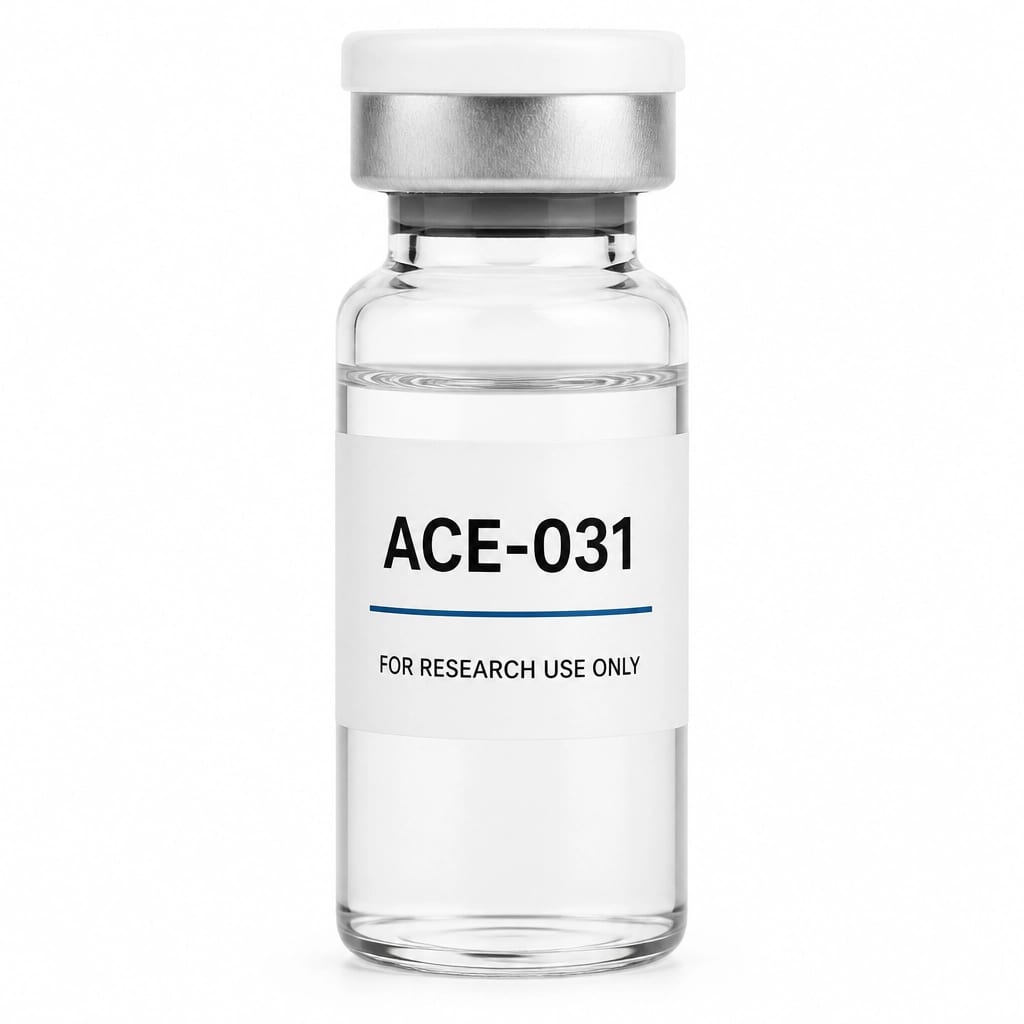
The Decoy Strategy: ACE-031
While Follistatin binds to the Myostatin itself, ACE-031 takes a different, broader approach. ACE-031 is a soluble “decoy” receptor. To understand this, imagine a game of musical chairs. Myostatin is looking for a “chair” (a receptor on your muscle cells) to sit on and deliver its “stop growing” message.
ACE-031 introduces thousands of “fake chairs” into your system. The Myostatin proteins land on these decoys instead of your actual muscle cells. Because these decoys aren’t attached to anything, the signal to stop growing is never delivered.
Broad-Spectrum Coverage
ACE-031 is often considered a “heavy hitter” because it doesn’t just block Myostatin; it also inhibits other ligands in the TGF-beta superfamily, such as Activin A. This provides a much broader coverage for muscle gain.
A word of caution: Because ACE-031 is so broad, it can affect other systems. Some researchers have noted vascular effects, such as minor nosebleeds or dilated blood vessels, due to its interaction with proteins involved in blood vessel integrity. When using a decoy strategy, you must be precise and observant of your body’s signals.