
1. The Bioavailability Bottleneck: Why Standard Peptides Fall Short
The Problem: Enzymatic Degradation in Biological Systems
Imagine trying to deliver a vital blueprint across a bustling construction site where aggressive demolition crews: known in biology as proteolytic enzymes: tear apart every piece of paper before it reaches the master architect. When standard peptides are introduced into biological environments, endogenous peptidases often dismantle their amino acid chains within minutes. Unmodified peptides suffer from extremely low oral bioavailability: often dropping below 1%: forcing researchers to rely heavily on precise delivery routes and structural hardening.
The Solution: Molecular Armor Through Chemical Engineering
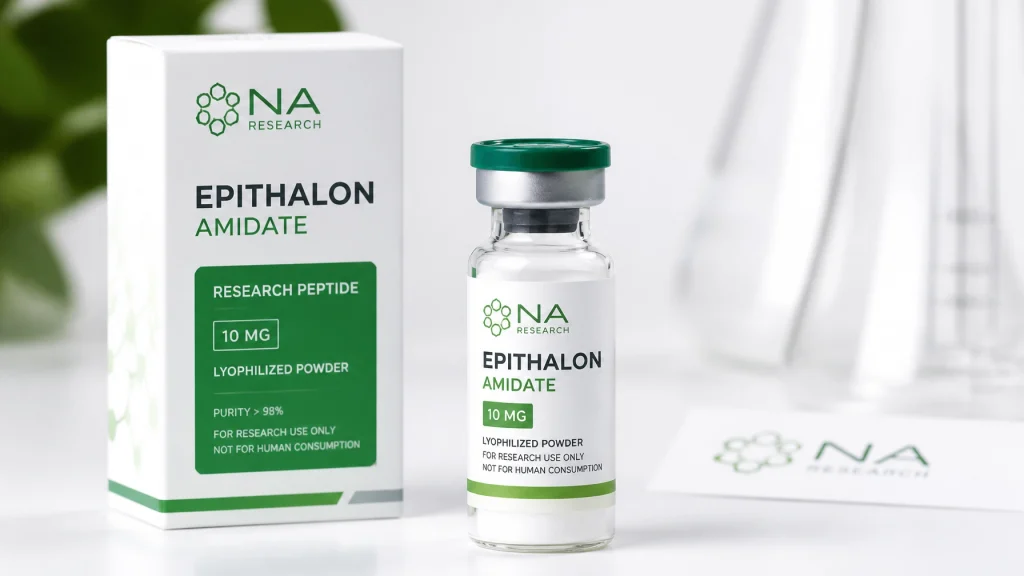
To solve this frustration, scientists apply targeted chemical modifications. In the case of NA Epithalon Amidate, two distinct structural alterations are performed:
- N-acetylation (adding an acetyl group at the N-terminus).
- Amidation (modifying the C-terminus).
Think of these modifications as industrial-grade shrink-wrap around a delicate package. They shield the peptide backbone from enzymatic scissors, drastically extending its half-life and ensuring greater systemic availability per microgram. Through this structural optimization, the peptide maintains its integrity longer, allowing for deeper cellular penetration and more consistent biological synergy.

2. Decoding NA Epithalon Amidate: Structure vs. Standard Epithalon
The Problem: Navigating Variant Confusion in Peptide Research
When reviewing literature, researchers often struggle to distinguish between standard Epithalon (a synthetic tetrapeptide composed of Alanine, Glutamic Acid, Aspartic Acid, and Glycine: Ala-Glu-Asp-Gly) and its N-acetylated, amidated counterpart. Without clear definitions, it is easy to misjudge dosage equivalencies or assume entirely different mechanisms of action.
The Solution: A Comparative Breakdown
Both compounds share identical core biological targets: specifically, telomerase upregulation and pineal gland modulation. However, their pharmacokinetic profiles differ significantly.
| Feature | Standard Epithalon | NA Epithalon Amidate |
|---|---|---|
| Structure | Unmodified tetrapeptide (Ala-Glu-Asp-Gly) | N-acetylated and C-amidated tetrapeptide |
| Enzymatic Resistance | Moderate; susceptible to rapid cleavage | High; protected terminals resist peptidases |
| Bioavailability | Lower systemic retention without specialized delivery | Enhanced metabolic stability and systemic retention |
| Research Focus | Foundational telomere elongation & pineal studies | Advanced pharmacokinetic efficiency & targeted longevity |
Focus on these structural nuances when designing your protocols. To calculate accurate concentrations for your laboratory work, utilize our dedicated reconstitution calculator.
