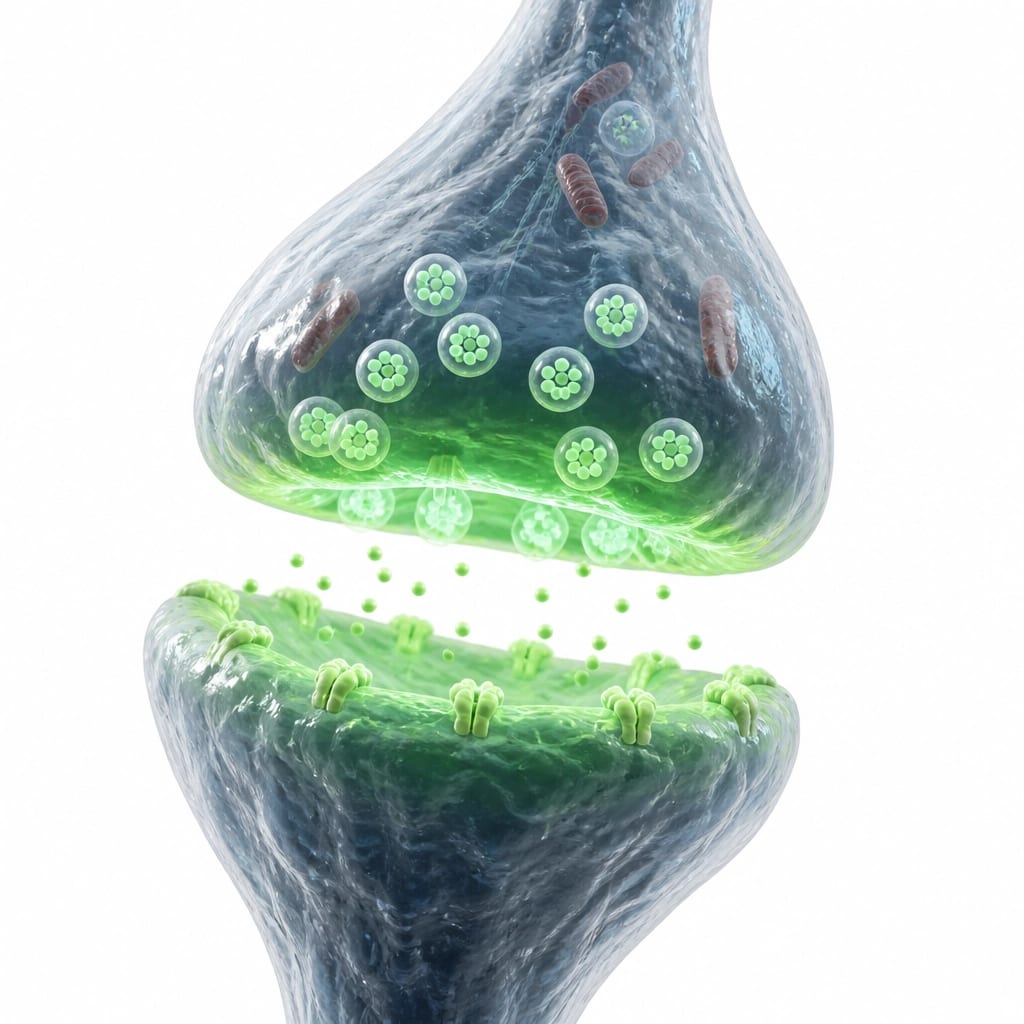
The Problem: The Brain’s “Pressure Relief Valve”
To understand PE-22-28, consider your neurons as a complex plumbing system. For a signal to travel, the “water pressure” (electrical charge) must build up until the neuron fires. However, your brain has safety valves called TREK-1 potassium channels. These channels allow potassium to leak out of the cell, which lowers the pressure and prevents the neuron from firing too easily.
In a healthy brain, this is a necessary safety feature. But in cases of chronic stress or low mood, these valves can become “stuck open.” When too much potassium leaks out, your neurons become hyperpolarized: essentially, they become too “quiet” and difficult to activate. This leads to the sluggishness, lack of motivation, and cognitive “heaviness” associated with various mood disorders.
The Solution: PE-22-28 acts as a custom-fitted “plug” for these TREK-1 valves. By selectively inhibiting these channels, PE-22-28 keeps the “pressure” where it belongs, making it easier for your neurons to fire and communicate. This process is known as TREK-1 inhibition, and in preclinical models, it has shown the potential to produce rapid antidepressant-like effects without the long wait times associated with traditional supplements.
The Spadin Evolution: Faster, Stronger, Longer
PE-22-28 was not invented in a vacuum. It was derived from Spadin, a 17-amino-acid peptide that naturally interacts with the sortilin receptor in the brain. Researchers discovered that they could strip Spadin down to its most active core: just 7 amino acids: to create PE-22-28.
Consider this the difference between a bulky old-school radiator and a modern, high-efficiency heat pump. Because it is smaller and more refined, PE-22-28 possesses a much higher affinity for its target. In scientific terms, it has an IC50 of approximately 0.12 nM. This means it takes a tiny amount of the peptide to achieve a massive effect on the TREK-1 channel.
| Feature | Spadin (Parent Peptide) | PE-22-28 (The Evolution) |
|---|---|---|
| Size | 17 Amino Acids | 7 Amino Acids |
| Potency (IC50) | 40–60 nM | ~0.12 nM (Highly Potent) |
| Duration of Action | ~7 Hours | ~23 Hours |
| Selectivity | High | Ultra-High |
As the table shows, one of the most significant advantages for the user is the duration of action. While Spadin only stays active for about 7 hours, PE-22-28 remains effective for nearly a full day. This “once-daily” biological profile makes it far more practical for long-term neural optimization.