
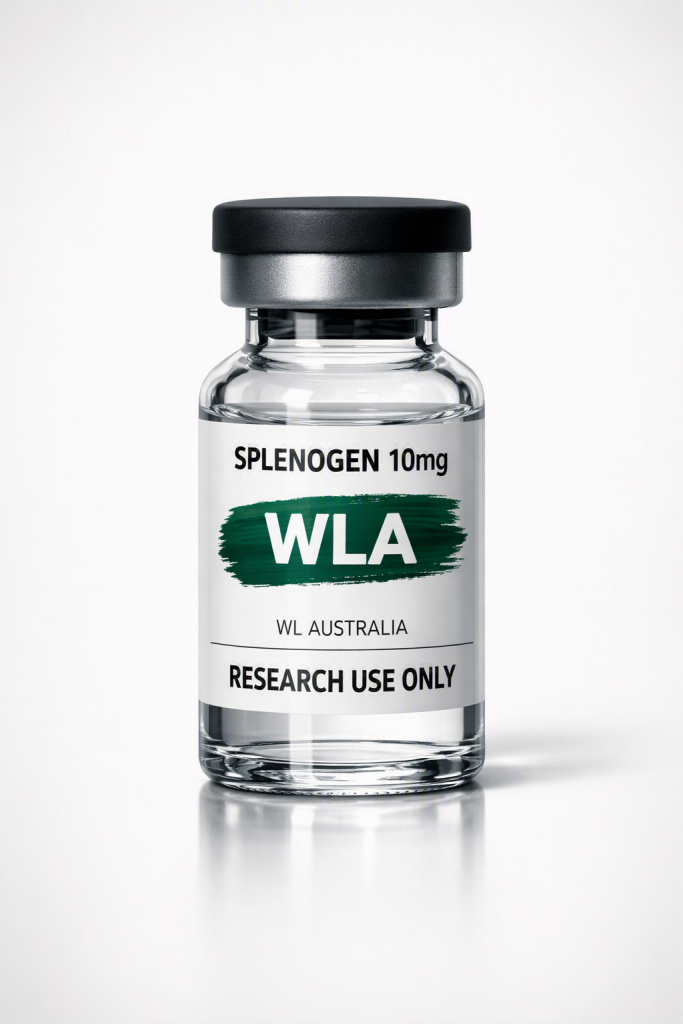
What Is Splenogen?
The problem: Product names can sound familiar, while the underlying formulation, route and evidence may be unclear.
The solution: Start with the exact listing rather than borrowing a protocol from a different product.
Splenogen 10mg is listed by WL Australia within the company’s Khavinson Bioregulators category. The product page describes Splenogen as an organ-specific peptide bioregulator associated with spleen research. It refers to very short peptide chains and proposed effects on cellular signalling, protein production and blood-cell formation.
However, those statements describe a proposed research mechanism. They do not establish that Splenogen:
- Treats an immune disorder
- Prevents infection
- Rebuilds spleen tissue
- Improves blood counts in humans
- Has a validated oral or capsule dose
- Is approved as a therapeutic medicine in Australia
The spleen acts like a combined security checkpoint, recycling centre and training academy. It filters blood, helps identify certain pathogens and supports immune-cell activity. That biology makes the spleen an interesting research target, but biological plausibility is not the same as clinical proof.
Video placeholder 1 : Understanding the spleen:
Add an educational video explaining the spleen’s role in blood filtration and immune surveillance. Avoid presenting Splenogen as a proven treatment.
Splenogen Capsule Dosage: What Is Actually Published?
The problem: Readers often search for a simple answer such as “How many capsules should I take?” The danger is that a dose from another spleen extract, peptide or animal study may be incorrectly applied to Splenogen.
The solution: Use a product-specific evidence table.
| Question | What can be confirmed for Splenogen 10mg? |
|---|---|
| Product strength shown on the listing | 10mg |
| Human capsule dose | Not published on the product page |
| Validated human dose | None established |
| Validated timing | None established |
| Human treatment indication | None |
| Listed status | Research chemical only: not for human use |
| Personal-use protocol | No safe protocol can be recommended |
There is an important distinction between product strength and human dose. The strength tells you how much material is associated with the research product. It does not tell you how much a person should take, how often it should be taken, or whether oral absorption produces a meaningful biological effect.
You should also avoid converting research material into capsules, tablets or other forms without validated formulation data. A capsule is not simply a small container. It is more like a delivery vehicle: the active material, excipients, stability, dissolution and absorption all influence what reaches the body.
How Should Researchers Document Dosage?
For an approved laboratory study, the protocol should record:
- Exact product name and batch or lot number
- Stated strength and formulation
- Intended research model
- Route of administration specified by the study
- Exposure amount in appropriate units
- Timing relative to observations or sampling
- Storage conditions
- Inclusion and exclusion criteria
- Adverse-event monitoring
- Stopping rules and reporting procedures
This is very different from giving a consumer a daily schedule. A legitimate study is governed by a research protocol, institutional oversight and qualified personnel. It does not rely on a generic internet dosage chart.
