
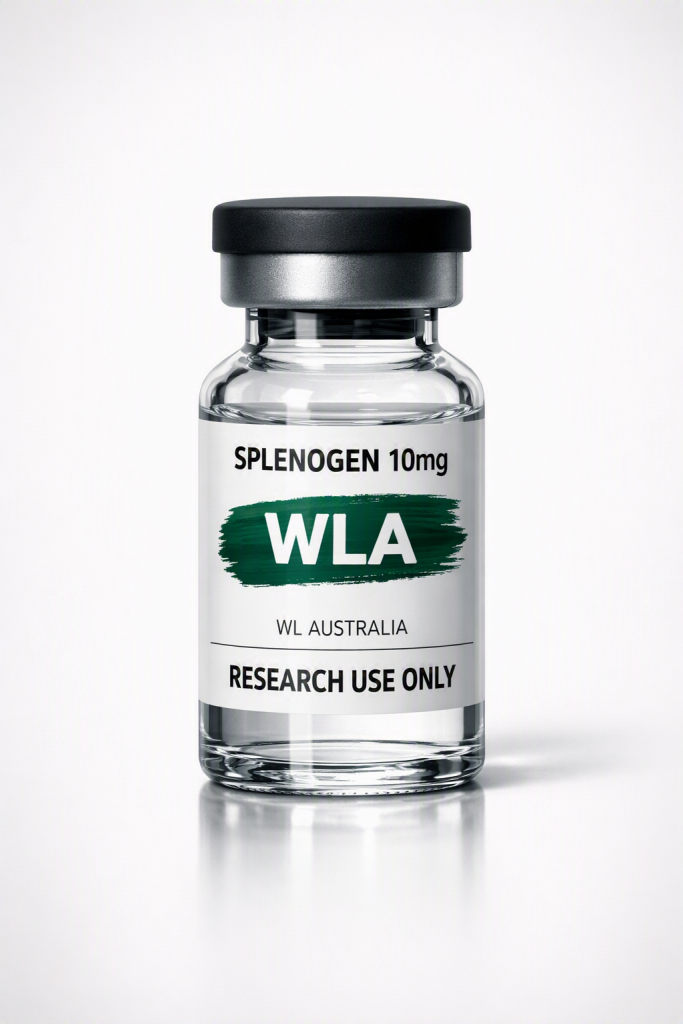
What is Splenogen?
The problem is simple: the word “bioregulator” can sound more established than the evidence actually is.
The solution is to separate what is known about the spleen from what is proposed about Splenogen.
Splenogen is marketed as an organ-specific peptide bioregulator associated with the spleen. The product listing describes ultra-short peptide chains, including dipeptides, tripeptides and tetrapeptides, and proposes that they may influence gene expression and protein synthesis in splenic cells.
Think of a cell as a construction site:
- DNA is the master blueprint.
- Messenger signals are the site instructions.
- Proteins are the finished components.
- The cell is the workforce.
The Khavinson model proposes that short peptides may act like instructions delivered to a specific biological “worksite”. In this case, the target is spleen-related tissue function.
However, this is a proposed mechanism, not proof that Splenogen produces a meaningful clinical result in humans. A review indexed by PubMed discusses peptide bioregulator research, but much of the wider evidence is preclinical, internally generated or not independently replicated.
Short version: Splenogen is a spleen-focused research product, not a proven immune therapy.

Why the spleen matters to your immune system
The frustration many people have with immune health is that the immune system seems invisible until something goes wrong. You may not feel your spleen filtering blood or coordinating lymphocytes, but it is performing important background work every day.
The spleen is the largest secondary lymphoid organ. That means it helps organise immune responses after immune cells have matured.
You can think of it as a combined airport security terminal and recycling centre:
- It screens blood for foreign particles and pathogens.
- It helps identify blood-borne antigens.
- It supports B-cell and T-cell activity.
- It removes ageing or damaged red blood cells.
- It recycles materials such as iron from old blood cells.
- It stores some platelets and immune cells.
The spleen has two major functional regions:
| Spleen region | Main role | Simple analogy |
|---|---|---|
| White pulp | Immune surveillance and lymphocyte activation | Security control room |
| Red pulp | Blood filtration and removal of old cells | Recycling and inspection station |
The NCBI overview of spleen physiology explains that the spleen supports immune function, blood filtration and blood-cell storage.
This matters when evaluating Splenogen because the product’s proposed target is not random. The spleen genuinely sits at the crossroads of blood, immunity and cellular clearance.
But biological relevance is not the same as clinical proof.
