
The Problem: The “Dual Agonist” Ceiling
Most weight loss journeys encounter a “frustration phase.” You focus on your macros, you maintain your movement, and you utilize a high-quality GLP-1 or dual GIP/GLP-1 agonist, yet the scale stops moving.
The reason? Your body is a survival machine. When you reduce calories, your metabolism often slows down to compensate: a process known as adaptive thermogenesis. A dual agonist like Tirzepatide 40mg is fantastic at turning down the “hunger signal” in your brain, but it doesn’t always address the “burning efficiency” of your internal furnace.
The Solution: Triple-Agonist Synergy
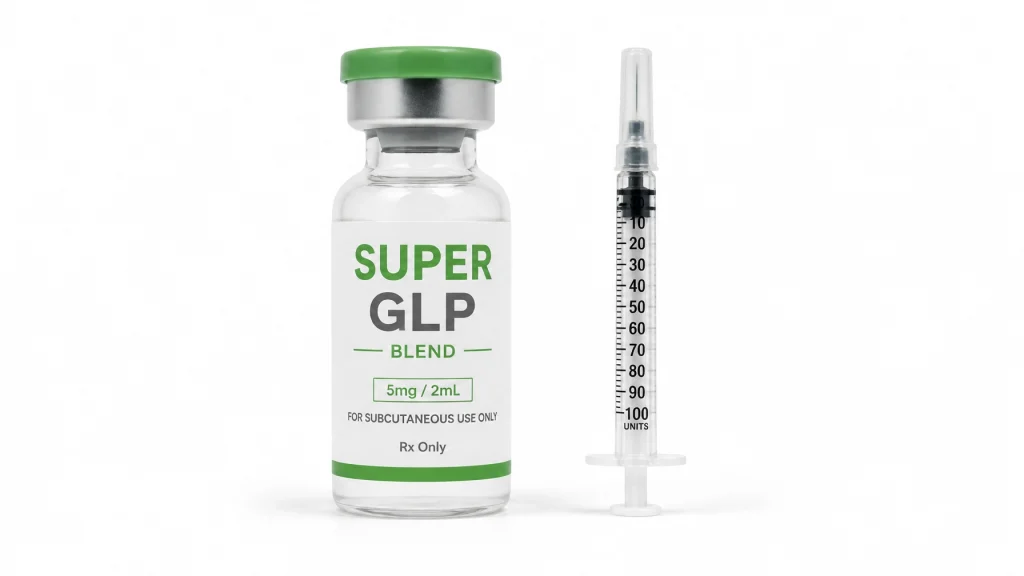
The Super GLP Blend ($350) is engineered to bypass this plateau. It combines 20mg of Retatrutide with 40mg of Tirzepatide to create a “Triple Threat” profile.
To understand why this is so effective, we need to look at the three levers of metabolism:
- GLP-1 (Glucagon-Like Peptide-1): Think of this as your brain’s volume knob for hunger. It tells your stomach to empty slower and your brain that you are satisfied.
- GIP (Glucose-Dependent Insulinotropic Polypeptide): This is the fuel efficiency expert. It improves how your body handles sugar and helps your fat cells behave more predictably.
- Glucagon: This is the turbocharger. While the first two focus on intake, Glucagon focuses on output. It signals the liver to burn stored fat and increases your resting energy expenditure.
How They Work Together: The Car Engine Analogy
Imagine your metabolism is a car engine.
- GLP-1 acts as the cruise control, keeping your fuel usage steady and preventing you from over-accelerating (overeating).
- GIP is the high-performance transmission, ensuring that every drop of fuel is used with maximum efficiency.
- Glucagon (the unique element in Retatrutide) is the turbocharger. It forces the engine to burn more fuel even when the car is idling.
While Retatrutide 20mg provides that necessary “burn,” the inclusion of Tirzepatide ensures the appetite suppression remains rock-solid and the transition is smooth.
