
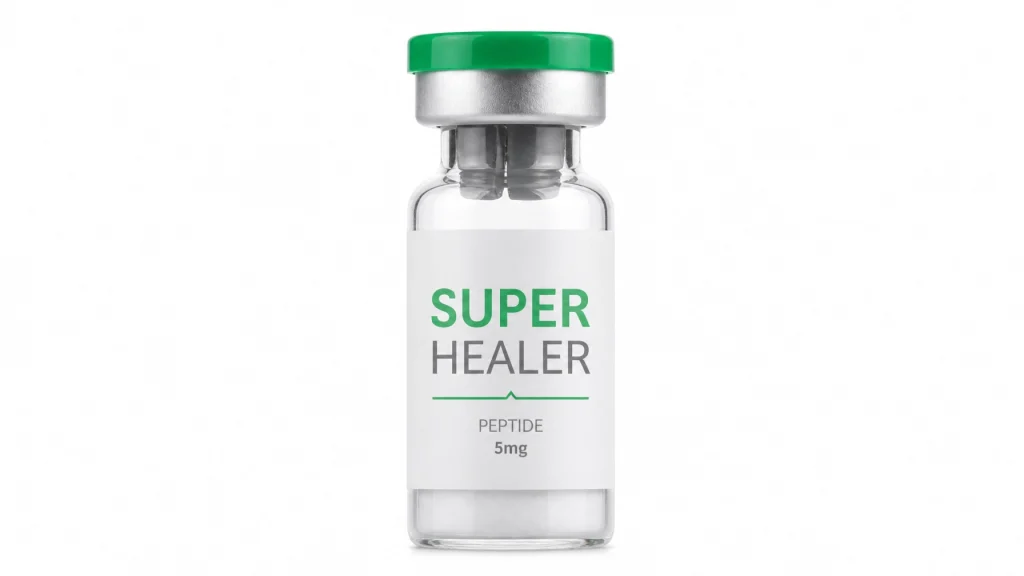
The Foundation: BPC-157 and TB-500
Before you can build a house, you need a stable foundation and a clear supply line. In the world of tissue repair, BPC-157 (Body Protection Compound 157) and TB-500 (Thymosin Beta-4) act as your Foreman and Logistics Manager.
BPC-157: The Site Foreman
BPC-157 is a synthetic peptide derived from a protein found in human gastric juice. Think of it as the foreman who arrives at the “construction site” (your injury) and immediately starts issuing orders to clear debris and start the rebuild.
- Problem: Inflammation and poor blood flow often prevent nutrients from reaching a damaged tendon.
- Solution: BPC-157 promotes angiogenesis: the creation of new blood vessels. By laying down these new “roads,” it ensures that the building materials your body needs can actually reach the site of the damage.
TB-500: The Logistics Manager
While the foreman organizes the site, the Logistics Manager: TB-500: ensures that cells can move freely to where they are needed most. TB-500 is a synthetic version of a naturally occurring peptide that regulates actin, a protein vital for cell movement.
- Problem: Damaged cells often become “stuck” or immobile, slowing down the healing process.
- Solution: TB-500 increases cell migration. It allows healthy cells to “travel” to the injury more efficiently, much like a traffic controller clearing a path for emergency vehicles.
Focus on this: BPC-157 builds the roads; TB-500 moves the workers. Together, they create the optimal environment for healing.

The Muscle Builders: MGF and IGF-1
Once the site is prepared and the logistics are handled, you need specialized “welders” to fuse the tissue back together. This is where the growth factors in the Super Healer stack come into play.
MGF (Mechano Growth Factor): The Specialist Welder
MGF is a variant of Insulin-like Growth Factor-1 that your body naturally produces after a muscle is stretched or injured. It is the “specialist” that triggers the activation of muscle stem cells (satellite cells).
- Problem: Severe muscle tears often lead to scar tissue rather than functional muscle.
- Solution: MGF forces these satellite cells to multiply, providing the raw biological material needed to fuse the muscle fibers back together. It is like adding a fresh layer of high-strength steel to a weakened bridge.
IGF-1 (Insulin-like Growth Factor-1): The Structural Engineer
IGF-1 is the overarching “engineer” of the project. It regulates the growth and development of nearly every cell in the body. In the Super Healer stack, it provides the systemic “green light” for growth and repair.
- Problem: Systemic recovery can be slow, especially as we age and our natural hormone levels fluctuate.
- Solution: By introducing a precise amount of IGF-1, you signal the body to prioritize protein synthesis and cellular repair. It ensures the “blueprints” for your recovery are followed to the letter.
Consider this: MGF handles the local repair of the specific tear, while IGF-1 manages the overall structural integrity of the tissue.
[INSERT VIDEO PLACEHOLDER: Understanding Growth Factors in Peptide Therapy]
