
The Genetic Handbrake: Understanding GDF-8 (Myostatin)
In our latest masterclass, Managing Hormones with Peptides, we discuss the body as a vast communication network. Every signal has a counter-signal. When it comes to building lean tissue, the primary “stop” signal is a protein called Growth Differentiation Factor 8 (GDF-8), more commonly known as Myostatin.
Think of Myostatin as the speed limiter on a supercar. Even if your engine (your training and nutrition) is capable of 300 km/h, the limiter (GDF-8) cuts the fuel at 150. In nature, this served an evolutionary purpose: muscle is metabolically expensive to maintain. Our ancestors didn’t always have access to high-quality protein, so the body evolved a way to prevent “excessive” muscle growth.
But for the modern researcher looking to unlock their full physiological potential, GDF-8 is simply a barrier to be overcome.
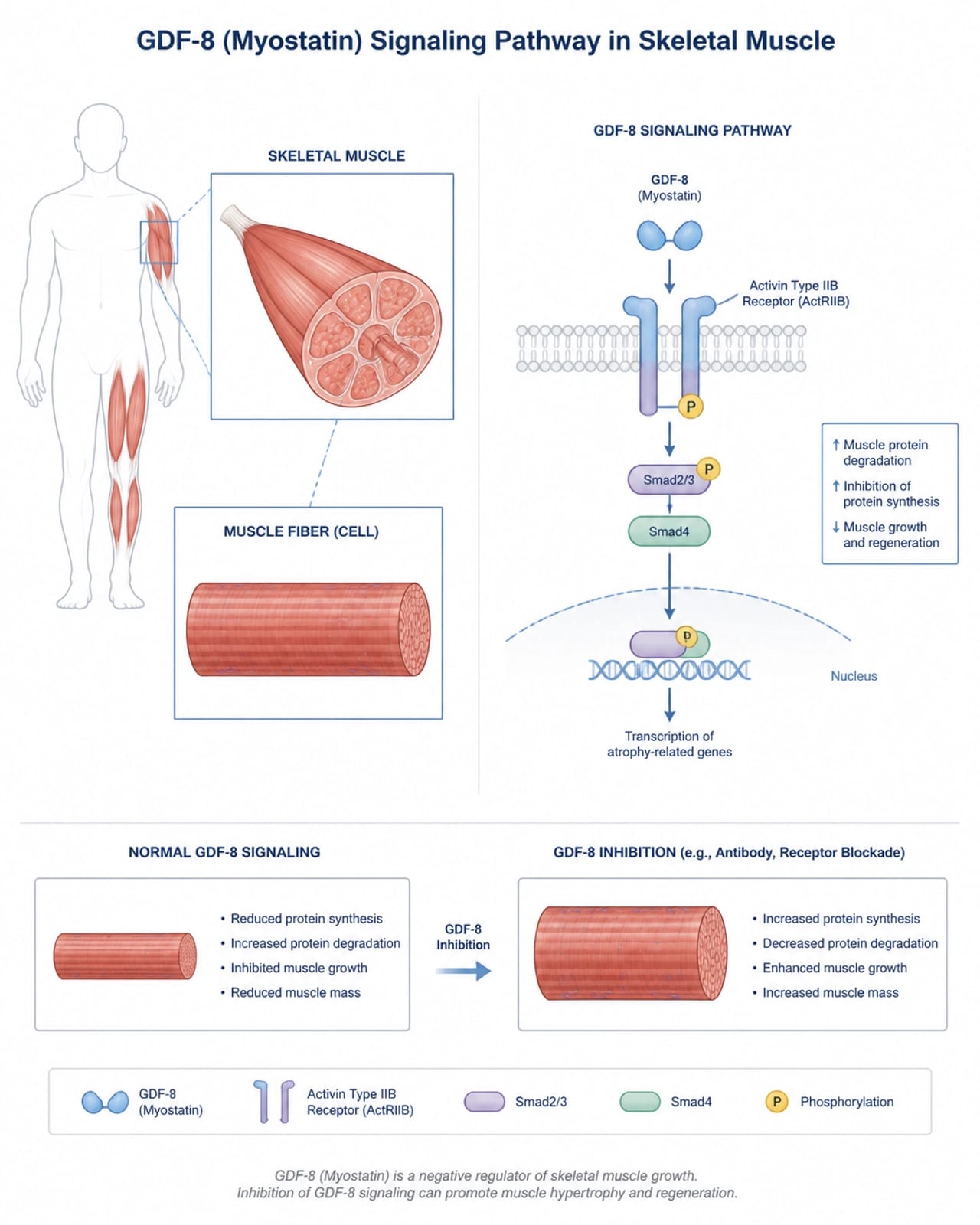
How Myostatin Inhibitors Work: Releasing the Pressure
A myostatin inhibitor doesn’t “add” muscle in the traditional sense; it revolutionizes growth by removing the biological inhibitor. When GDF-8 levels are suppressed, the signaling pathways for protein synthesis: specifically the Akt/mTORC1 pathway: are allowed to run at full throttle.
There are two primary research compounds currently leading the charge in GDF-8 blockade:
- Follistatin (FST-344/315): This is a naturally occurring glycoprotein that acts as a “ligand trap.” It binds to myostatin before it can even reach your muscle cell receptors, effectively neutralizing the signal.
- ACE-031: A soluble decoy receptor. It mimics the receptor that myostatin normally binds to, “soaking up” the GDF-8 in your system so your actual muscle tissue never feels the “stop” command.
By utilizing these inhibitors, researchers have observed rapid transformations in lean mass, often bypassing plateaus that have lasted for years.
