
You have a biological clock ticking inside every single cell of your body. It isn’t measured by gears and springs, but by microscopic “caps” on the ends of your DNA called telomeres.
Imagine the plastic tips on the ends of your shoelaces. These tips, known as aglets, prevent the laces from fraying. Telomeres serve the exact same function for your chromosomes. Every time a cell divides to create a new one, those “caps” get a little bit shorter. When they get too short, the “lace” (your DNA) starts to fray, the cell stops working, and it enters a state of senescence: essentially becoming a “zombie cell.”
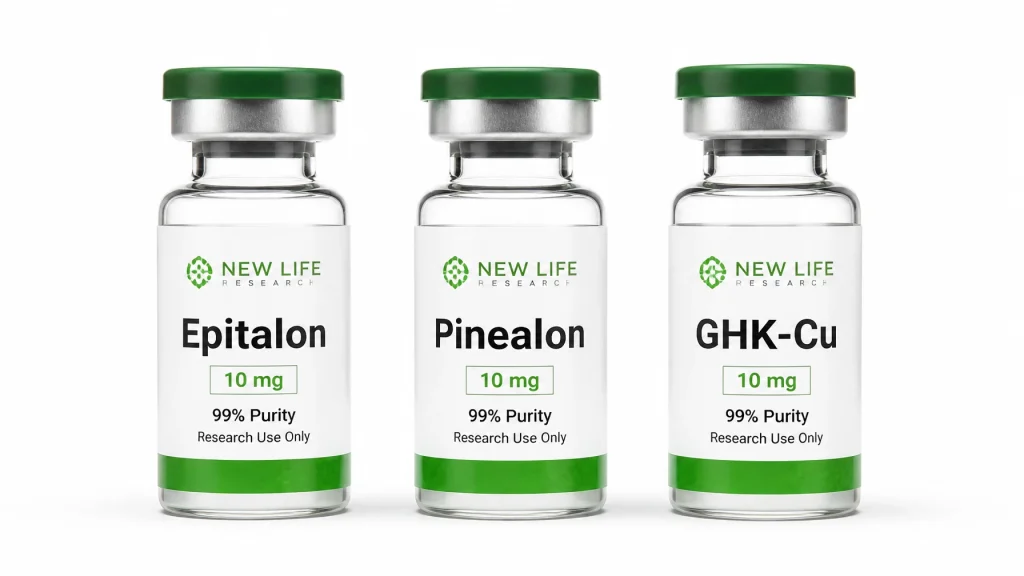
In this guide, you will learn how specialized peptides like Epitalon, Pinealon, and GHK-Cu (Glycyl-L-histidyl-L-lysine–copper) are being researched to interact with this cellular clock. We will dive into the science of telomerase activation and cellular repair to help you understand if you can truly “wind back” your biological age.
The Problem: Replicative Senescence and the Hayflick Limit
The core frustration of aging is the Hayflick Limit. This is a biological law stating that a normal human cell can only divide about 40 to 60 times before it can no longer replicate.
