
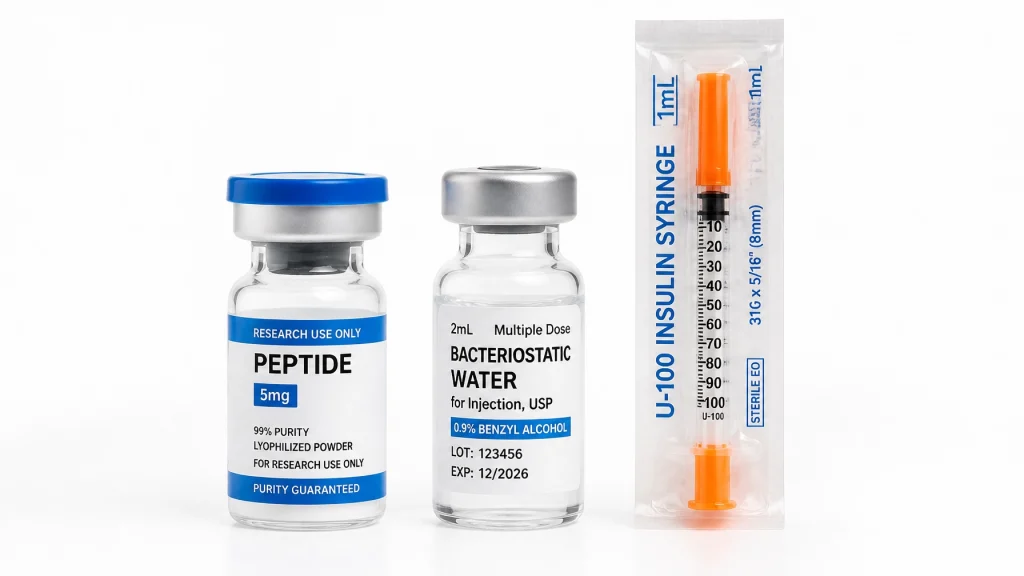
The Foundation: Understanding Units and Measurements
Before we pick up a syringe, we must define our terms. In the world of peptides, we deal primarily with two measurements: Milligrams (mg) and Micrograms (mcg).
Think of a Milligram as a shipping container. Inside that container are 1,000 individual boxes called Micrograms.
- 1 mg = 1,000 mcg
- 5 mg = 5,000 mcg
Most vials you purchase, like a 50mg vial of Epitalon, are labeled in milligrams. However, your daily dose is almost always measured in micrograms. If you confuse these two, you are essentially trying to fit a shipping container into your garage: it’s a recipe for disaster.
The Equipment: The U-100 Syringe
Most research is conducted using U-100 Insulin Syringes. These are standard 1mL syringes divided into 100 “units.”
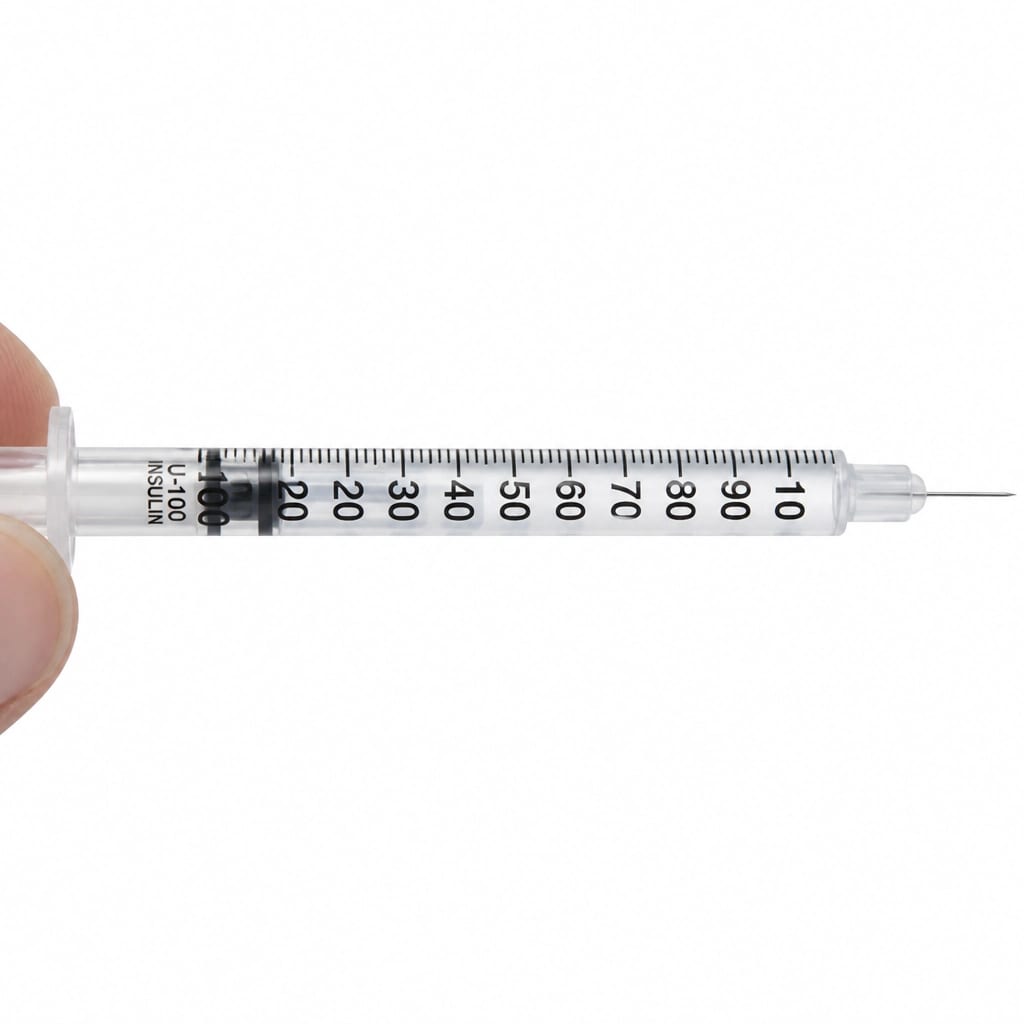
Focus on this: A “unit” is not a fixed amount of a drug; it is a measurement of volume. How much peptide is in one unit depends entirely on how much liquid (Bacteriostatic Water) you added to the vial.
Problem-Solution: The Reconstitution Math
The Problem: You have a 5mg vial of dry powder. You need a 250mcg dose. How many units do you pull into the syringe?
The Solution: Follow the three-step “Concentration Logic.”
Step 1: Convert the Vial to Mcg
Take the mg on the label and multiply by 1,000.
- 5mg x 1,000 = 5,000 mcg total.
Step 2: Determine Your Concentration
Decide how much Bacteriostatic (BAC) water to add. Adding 2mL (200 units) is a standard industry practice because it makes the math easy to digest.
- 5,000 mcg / 2mL = 2,500 mcg per mL.
Step 3: Find Your Unit Value
Since a U-100 syringe has 100 units in 1mL, we divide our concentration by 100.
- 2,500 mcg / 100 units = 25 mcg per unit.
The Worked Example:
If 1 unit = 25 mcg, and your target dose is 250 mcg, you simply divide:
- 250 / 25 = 10 units.
| Vial Size | BAC Water Added | Resulting Concentration | Units for a 250mcg Dose |
|---|---|---|---|
| 5mg | 2mL | 25mcg / unit | 10 Units |
| 10mg | 2mL | 50mcg / unit | 5 Units |
| 2mg | 1mL | 20mcg / unit | 12.5 Units |
