

What Is Peptide Stacking?
The problem: One signal may not address the whole system
The immune system has several moving parts. A single peptide may be studied for one pathway or tissue, but immune resilience depends on communication between multiple organs and cell types.
Think of your immune system as a sports team:
- The thymus acts like the training academy for T-cells.
- The immune signalling network acts like the communication system between players.
- The bone marrow acts like the club’s talent factory, producing new blood and immune cells.
- The spleen and lymphatic tissues help filter, organise and deploy immune resources.
A multi-layered approach attempts to support these different roles in sequence rather than treating immunity as a single, isolated function.
The proposed solution: Combine targeted and broad signals
Synthetic peptides are presented in the foundational document as more precise, short-chain signals. Natural extracts are described as broader complexes containing multiple peptides.
The theory is simple:
- Start with focused signalling.
- Follow with broader tissue support.
- Maintain the bone-marrow foundation throughout.
That is the proposed synergy. Fast signal. Sustained support. New-cell foundation.
The Four Components of the Immune Stack
Crystagen: targeted thymus research

The thymus is where many T-cells mature and learn to distinguish the body’s own cells from foreign targets. It naturally changes with age, which has made thymus-related peptides an area of ongoing research.
In the supplied framework, Crystagen 20mg is used in the immediate-boost phase as a synthetic, thymus-targeted peptide.
The proposed role is to provide a focused cellular signal. In practical terms, it is treated like sending a clear instruction to the immune training academy.
Current evidence remains limited. Available research is mainly preclinical or based on small, region-specific reports. Crystagen should not be presented as a proven treatment for infection, immune deficiency or disease.
Vilon: immune communication research

Vilon 10mg is a synthetic dipeptide associated with research into cellular regeneration, lymphocyte activity and immune communication.
The foundational protocol places Vilon beside Crystagen during the first 10 days. The purpose is complementary: Crystagen provides a thymus-focused signal, while Vilon is positioned as a communication-support compound.
A useful analogy is a construction site. Crystagen represents the project brief. Vilon represents the radios that help the workers coordinate.
This proposed function should be interpreted cautiously. Human safety and effectiveness data for Vilon are not well established, and the compound is not a substitute for clinical care.
Vladonix: broader thymus-derived research
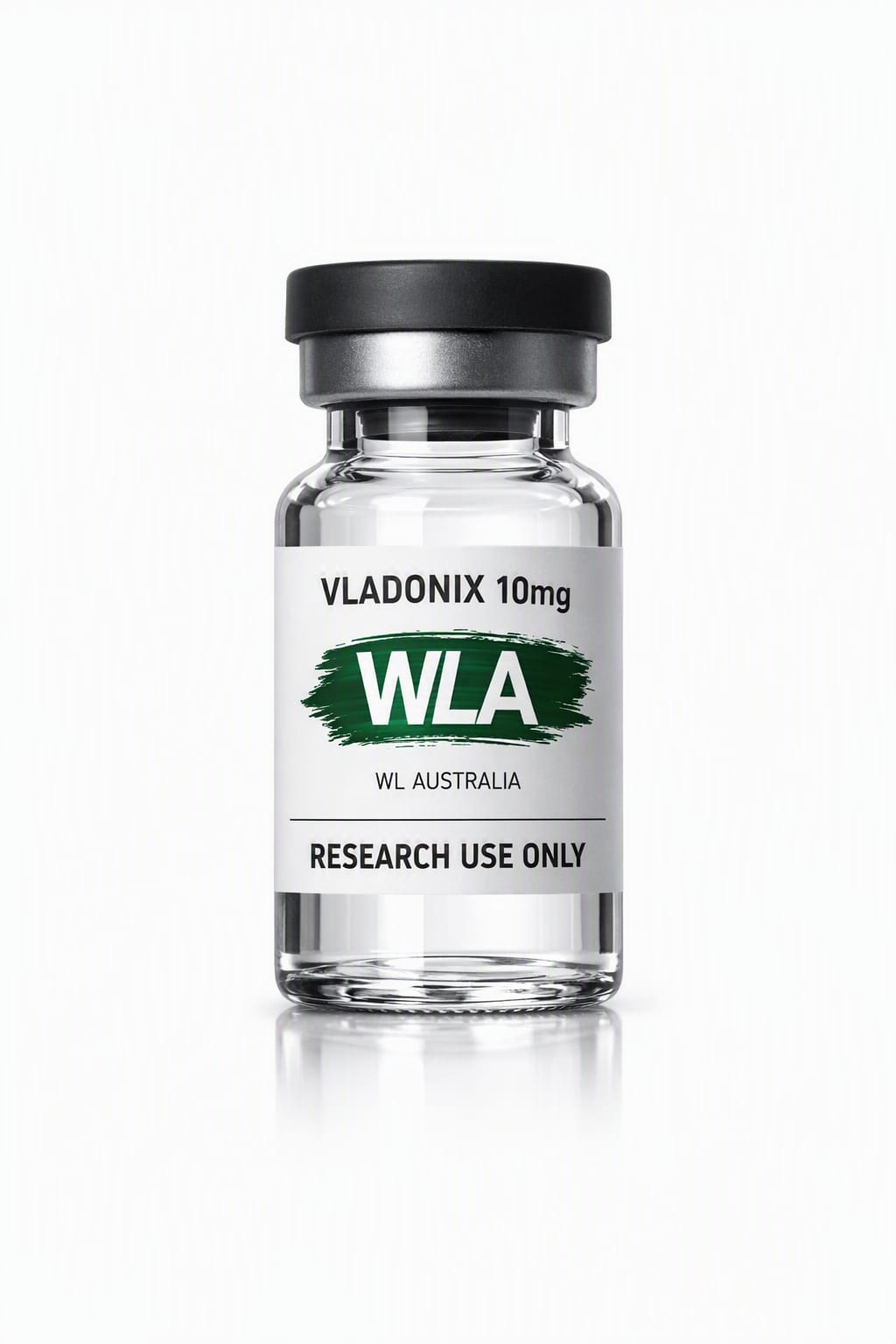
Following the synthetic phase, the framework transitions to Vladonix 10mg, a thymus-derived peptide product described as a broader natural extract.
The supplied document positions natural extracts as slower and more comprehensive than isolated synthetic peptides. Vladonix is therefore used as the maintenance layer after the initial 10-day signal phase.
The analogy is straightforward:
- Synthetic peptides are like a precise text message.
- Natural extracts are like a complete operations manual.
The proposed benefit of this transition is continuity. The first phase delivers focused signals; the second phase provides broader thymus-related research support.
WL Australia’s product page clearly states that Vladonix is a research chemical only: not for human use. It should not be used to manage infections, replace prescribed treatment or delay medical assessment.
Bonomarlot: bone-marrow foundation research

The immune system needs a supply of new cells. Bone marrow is the body’s blood-forming factory, producing red blood cells, white blood cells and platelets.
Bonomarlot 10mg is included throughout the proposed protocol to support bone-marrow research.
This creates the foundation layer of the stack. If the thymus is the training academy, bone marrow is the recruitment centre. The goal of including Bonomarlot throughout is to address the supply side of immune-cell production while the other peptides focus on signalling and thymus-related pathways.
Evidence for Bonomarlot is early-stage. There are no strong, independently replicated human trials establishing that it improves immunity, anaemia, blood-cell production or lifespan. The product must therefore be treated as experimental research material.
