
The Master Conductor: The Pineal Gland
Before we get into the peptide itself, let’s talk about the hardware. Nestled deep within the brain is the pineal gland. It’s tiny, shaped like a pinecone (hence the name), and is responsible for producing melatonin.
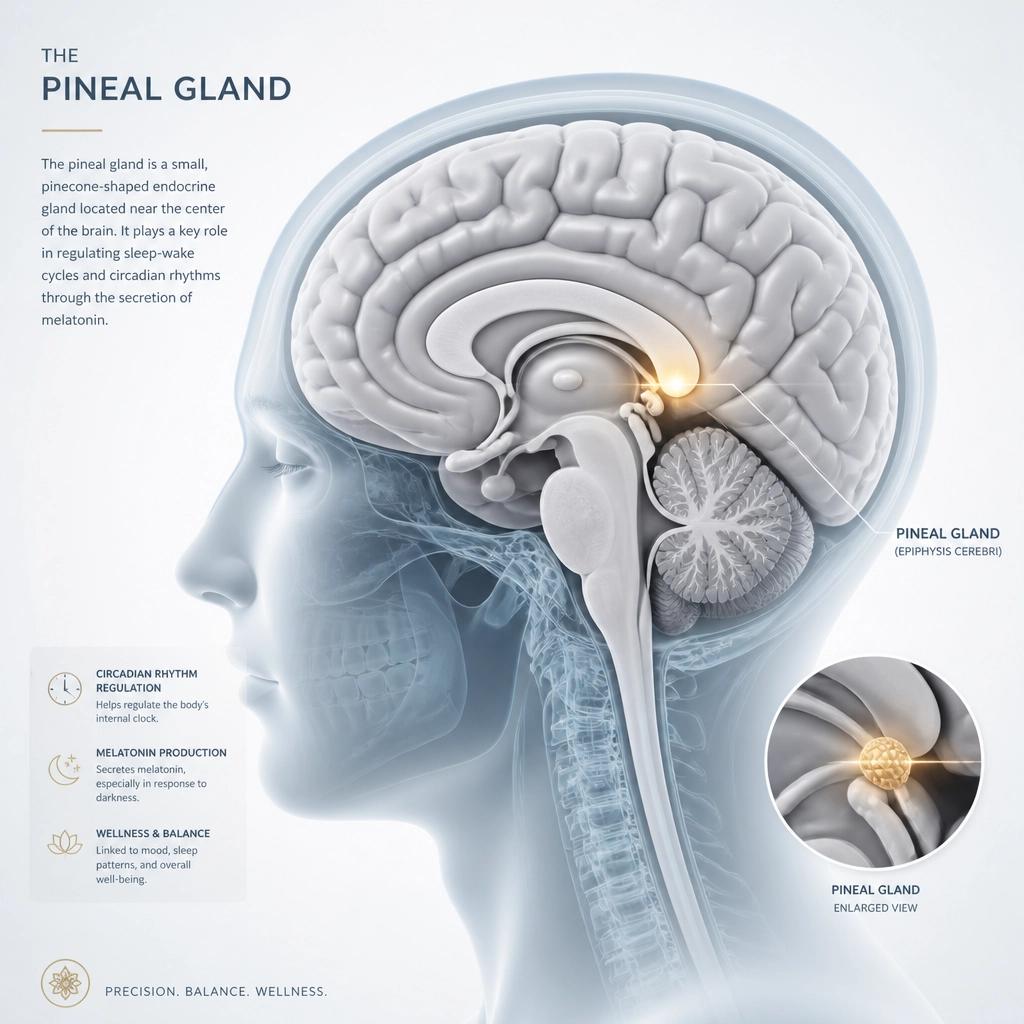
Your circadian rhythm, the internal clock that tells you when to wake up and when to wind down, is entirely dependent on the health of this gland. However, as we age, or as we subject ourselves to the high-stress, blue-light-soaked environment of modern life, the pineal gland begins to calcify and lose its efficiency. This leads to fragmented sleep, lower melatonin production, and a general feeling of being “out of sync.”
What is Pinealon?
Pinealon is a short-chain bioregulator consisting of three amino acids: Glutamic acid, Aspartic acid, and Arginine (Glu-Asp-Arg).
Developed through decades of research into peptide bioregulation (the Khavinson method), Pinealon is engineered to penetrate the blood-brain barrier and interact directly with the DNA of the pineal gland and the central nervous system. Unlike traditional sleep aids that act as sedatives, Pinealon is a bioregulator. It doesn’t force you to sleep; it attempts to restore the biological function of the tissue itself.
In our world of Scientific Luxury, Pinealon represents the “Gold Standard” for neurological maintenance. It’s about precision. It’s about providing the body with the exact molecular keys it needs to unlock optimal function.