
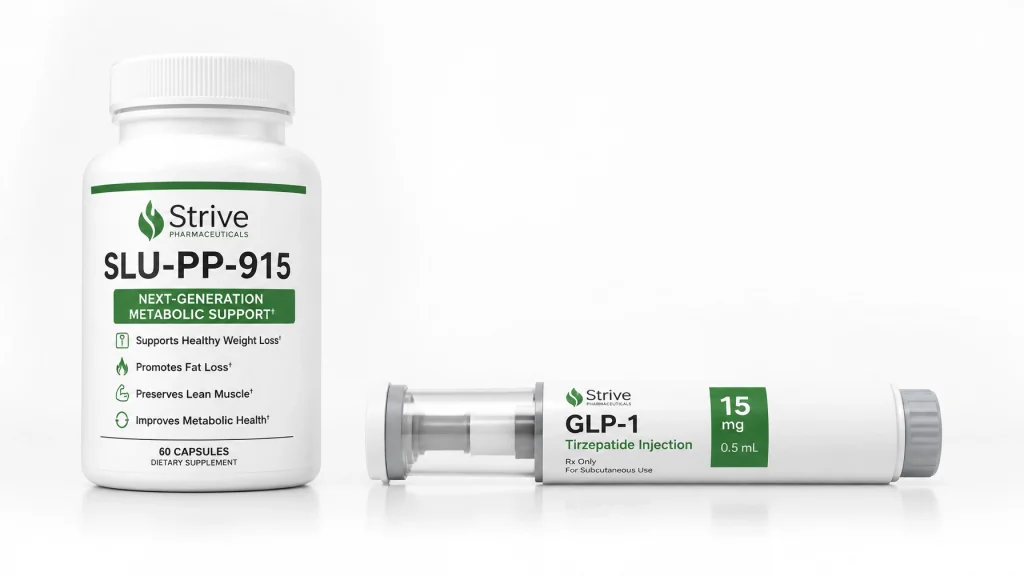
The Problem: The “Catabolic Trap” of Rapid Weight Loss
When you use a GLP-1 agonist, your appetite drops significantly. This creates a large caloric deficit: the “problem” of having more energy going out than coming in. While this leads to weight loss, it can also lead to a “catabolic” state.
Catabolism is when your body breaks down its own tissues for energy. Think of it like a construction crew that has run out of new bricks, so they start pulling bricks out of the existing walls to keep the lights on. Frequently, those “bricks” come from your muscle tissue rather than your fat stores. This leads to a slower metabolism and a softer physical appearance.
The Solution: A Tiered Metabolic Strategy
To avoid this trap, you need a strategy that addresses both sides of the energy equation:
- Lowering Intake: Managed by GLP-1 agonists.
- Raising Output: Managed by SLU-PP-915.
By combining these, you create a “pincer movement” on body fat, attacking it from two different biological directions.
Part 1: GLP-1 Agonists : The “Fuel Tank” Managers
GLP-1 (Glucagon-Like Peptide-1) agonists work primarily by mimicking hormones that tell your brain you are full.
- Semaglutide: Focuses purely on the GLP-1 receptor to slow digestion and signal satiety.
- Tirzepatide: Adds a second pathway (GIP) that improves how your body handles sugar.
- Retatrutide: The “triple threat” that adds a third pathway (Glucagon) to slightly increase heart rate and fat burning.
Focus on this: While these are incredible for reducing “calories in,” they don’t necessarily optimize how your cells use energy once it’s inside. If your cellular “power plants” are dormant, even a low-calorie diet can feel like an uphill battle.
[INSERT VIDEO PLACEHOLDER: How GLP-1 Agonists Change Your Relationship With Food]
