What is the CRF peptide family?
The problem: stress biology involves several overlapping signals
The stress response is not controlled by one isolated molecule. It works more like an emergency management system, with different teams coordinating hormones, blood vessels, the heart, appetite and behaviour.
The CRF family includes:
- CRF, also called corticotropin-releasing hormone or CRH
- Urocortin 1
- Urocortin 2
- Urocortin 3
These peptides interact with CRF receptors located in the brain, pituitary gland, heart, blood vessels and other tissues.
The solution: map the system before focusing on one peptide
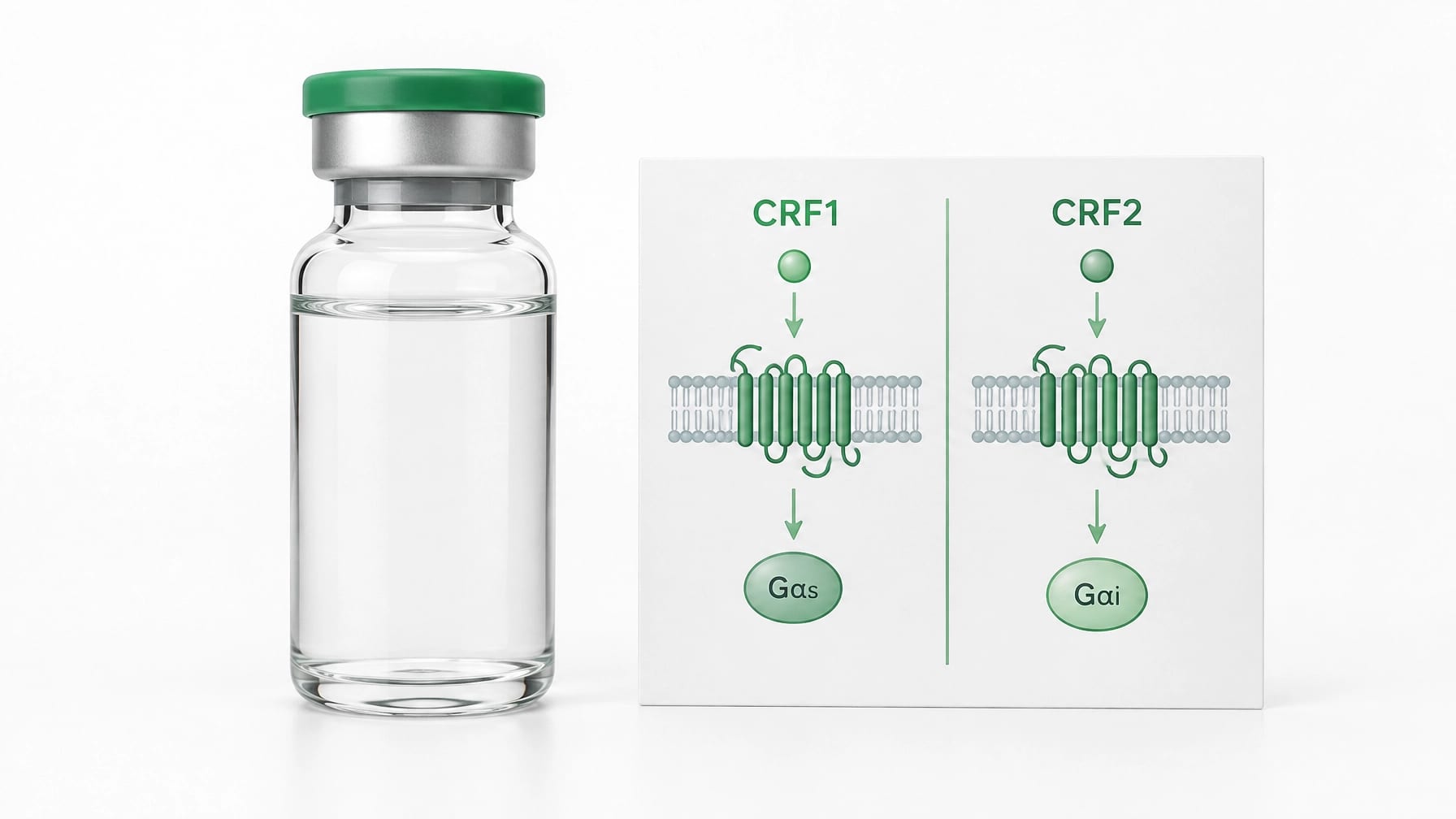
The main receptors are:
| Receptor | General research association |
|---|---|
| CRF1 | Classical stress signalling, hypothalamic–pituitary–adrenal axis activity and stress-related behaviour |
| CRF2 | Stress adaptation, vasodilation, cardiovascular signalling, appetite suppression and energy balance |
The hypothalamic–pituitary–adrenal axis, commonly called the HPA axis, is the body’s central stress-response chain:
- The hypothalamus releases CRF-related signals.
- The pituitary gland releases adrenocorticotropic hormone, or ACTH.
- ACTH stimulates the adrenal glands to produce cortisol.
- Cortisol feeds back to the brain and pituitary to help limit the response.
You can think of the HPA axis as a thermostat. It should turn the stress response up when needed and turn it back down when the threat has passed. Problems arise when the system becomes too active, poorly regulated or slow to reset.
Short version: CRF-family peptides help coordinate the body’s stress thermostat.
Urocortin 1 versus CRF, Urocortin 2 and Urocortin 3
The problem: similar peptides can produce different biological patterns
CRF and the urocortins are related, but they do not interact with the receptors in exactly the same way.
CRF primarily favours CRF1, making it a key driver of the classical HPA-axis stress response. Urocortin 1, in contrast, has high affinity for both CRF1 and CRF2.
That dual activity makes Urocortin 1 more like a signal that can access two different departments:
- Through CRF1, it may contribute to arousal, HPA-axis activation and anxiety-related responses.
- Through CRF2, it may influence vasodilation, cardiovascular function, appetite and stress coping.
Urocortin 2 and Urocortin 3 are different again. They are generally described as CRF2-selective ligands. This receptor preference makes them useful research tools when scientists want to examine CRF2 biology without activating CRF1 to the same extent.
| Peptide | Main receptor profile | Why researchers study it |
|---|---|---|
| CRF | Primarily CRF1 | Stress initiation and HPA-axis regulation |
| Urocortin 1 | High affinity for CRF1 and CRF2 | Combined stress, cardiovascular, appetite and mood biology |
| Urocortin 2 | Predominantly CRF2-selective | Cardiovascular, appetite and stress-adaptation research |
| Urocortin 3 | Predominantly CRF2-selective | CRF2 signalling, energy balance and behavioural research |
Short version: Urocortin 1 is the dual-receptor member; Urocortin 2 and 3 are more CRF2-focused.