
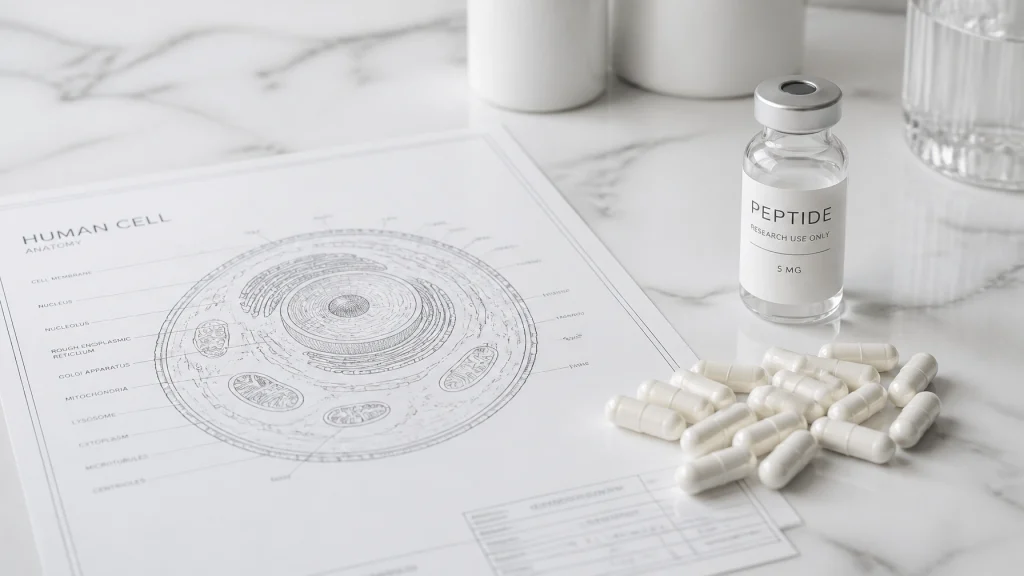
Peptides Versus Traditional Supplements: The Size and Signal Difference
To understand why your current routine might be lagging, we need to look at the fundamental science. Understanding the core function of peptides helps clarify why they stand out in the pursuit of healthier aging.
Peptides are short chains of amino acids, which are the building blocks of proteins. Your body naturally produces many types of peptides, each with a unique job, acting as tiny messengers that tell cells what to do.
Think of proteins as long necklaces, and peptides as much shorter ones. Each “bead” is an amino acid. Specifically, peptides contain between 2 and 50 amino acids. This small size is key; it allows them to move easily throughout your body and slip into cells much more readily than larger, clunkier proteins.
Consider how traditional supplements work. A common vitamin provides a nutrient your body needs for various processes. Vitamin C helps with immune function and collagen production, but it doesn’t tell a specific skin cell to produce more collagen in a targeted area. It just sits there, hoping to be used.
Peptides, conversely, deliver precise commands. They aren’t just “there”; they are active.

The Power of Specific Instructions
One primary reason to choose peptides over standard vitamins for longevity is their ability to deliver targeted signaling. Peptides act like keys that fit into specific locks on cell surfaces, known as receptors. This interaction triggers a precise response within the cell, telling it to repair, regenerate, or modulate its activity.
Instead of just providing “general support,” peptides give the body detailed architectural plans for specific repairs.
For instance, a bioregulator peptide like Vesugen specifically targets the cells lining blood vessels, helping to support heart health. It doesn’t just provide general cardiovascular support; it directs those specific cells to function optimally. This precision allows for focused improvements rather than broad, less directed effects.
Another powerhouse in the longevity space is Epithalon. As we age, our DNA can suffer damage, leading to cellular decline. Epithalon works by influencing the activity of an enzyme called telomerase, which helps maintain the protective caps on our chromosomes (telomeres). Longer telomeres are associated with healthier, younger cells.
By using Epithalon, you aren’t just “taking a vitamin for DNA”; you are sending a direct order to your cells to Unlock their regenerative potential and Combat the natural shortening of life-spans.